
Edvard Munch, Der Schrei der Natur (The Scream)
The most important thing about a Crisis Communications Plan is having one – before it’s needed. Yesterday, Heather Whaling posted a nice and simple five step Crisis Communication Plan on her prTini blog. I thought was a great start and worth sharing:
1 – Establish the Crisis Team
2 – Identify and Prepare the Spokespeople
3 – Develop processes and protocols
4 – Prepare for New Media’s Impact on Crisis Communication
5 – Brainstorm Possible Scenarios & Responses – Role Play – Repeat
One of my first experiences with implementing a crisis communications plan was in the fall of 1999 as Microsoft braced for the “Millennium Bug”. What promised to be Microsoft’s equivalent of the Exxon Valdez oil tanker disaster (1989) or Odwalla’s E. coli outbreak (1996), ultimately turned out to be a bit of a letdown. At least it seemed that way at the time, all that work and no crisis! Of course the best crisis is one that is averted. The second best crisis is one for which you are prepared.
Less than a year later I experienced the latter. In the fall of 2000 I was working on the Windows news team leading the efforts to bring a more approachable Microsoft story to the “broad-reach” consumer press not traditionally interested in PC technology. These types of publications often have long lead times. For example, the article for the September issue of Good Housekeeping had to be submitted in June, and that was the extended deadline! In order to meet these lead times, I had provided pre-release versions of Windows Millennium Edition with all the “bells and whistles”. I also worked closely with my press contacts to assure they had positive experiences. Things were going well and many of the articles were long “put to bed” by the time the product launch rolled around. But within days after the public release of the new operating system the Windows team was under siege. Short lead reviewers at city newspapers (“metros”) were writing negative reports and the nascent online communities (this was 12 years ago) were posting about their bad experiences, influencing a whole new round of unexpected coverage. The negative reports were beginning to snowball and soon the narrative became “Windows ME is a Disaster” and news stories were being published about the negative reaction to the operating system release, rather than the products’ features and benefits.
In response we implemented our crisis plan. We set up a central command center staffed 24 hours a day to respond to negative news reports and to highlight the positive ones. We reached out to reassure our well established media contacts and scrambled to provide product information to a whole new set of press targets. Within a few days we were able to stem the tide but Windows ME never really shook its reputation as the Windows “Mistake Edition”. It wasn’t until a year later, with the launch of Windows XP, that Microsoft was able to wipe the slate clean.
An after action review (internal post-mortem) revealed that a good deal of the negative reaction was due to confusion and inadequate preparation for Windows’ different target audiences. Windows ME was a consumer (not business) operating system with some cool pioneering features including Movie Maker, a much improved Media Player and the first version of the System Restore recovery utility. This was good stuff and we spent a good deal of time reaching out to the consumer press about it. But we hadn’t adequately or convincingly informed business and technical press. We knew that this product was not for them, but we failed to assure that they knew.
The Windows ME launch was a trivial crisis when compared with the potential loss of life and property from the “Millennium Bug” or the environmental damage from the Exxon Valdez oil tanker disaster or the deaths from Odwalla’s E. coli outbreak. But my early experience as part of a crisis communications team left me with two valuable lessons: do everything you can to avoid a crisis and, just in case, make sure you have a plan!

A Kony2012 graphic from Invisible Children
Playing off the 2012 elections in USA, the Kony 2012 campaign employs videos, social media, street art, and good old-fashioned street demonstrations to make the case that the arrest of Joseph Kony is one thing we can all agree upon this year. The KONY 2012: Invisible Children video is reportedly the fastest growing viral video phenomenon to date. Within a week it has been viewed over 70 million times. This is an incredible figure – we’re talking Charlie bit my finger! numbers here. Only that humorous video is 56 seconds long – conventional wisdom’s “sweet spot” for viral video. This video is nearly 30 minutes long and not funny at all. Yet, it is well on its way to joining the exclusive 100 Million Viral Views Club.
It’s an understatement to say that the video has caused quite a stir. At first because it exposed the story and then because of the backlash it raised. One of the better backlash blogs was written by Grant Oyston, a sociology and political science student at Acadia University in Nova Scotia, Canada. The Invisible Children’s organization recently posted a response to that and other negative reports. Both are great reading for anyone trying to understand more about the controversy.
But behind that controversy there’s a world class integrated social media marketing campaign that is already becoming the stuff of legend. The video is upfront about being a deliberately designed marketing campaign. They open with the words, “There are more people on Facebook than there were on the planet 200 years ago… humanity’s greatest desire is to belong and connect” and their intention to tap into this desire. The KONY 2012 video later explains their plan to target influentials in show business and politics to be their advocates. They back this up with polished videos, a professional website, extensive merchandise, street art, face-to-face interaction, and more. In short – wow. Say what you will about Invisible Children’s dubious finances, simplified narrative and support for military intervention by the allegedly corrupt Ugandan army, their marketing plan is superb. We’re talking Harvard Business Review case study caliber. You can bet that the MarComm and social media pros at many top companies are already studying the strategies and tactics used here. I know I am.
For more information (and how to participate) check out the Invisible Children’s website at http://www.invisiblechildren.com.
Lord knows the world doesn’t need another article about Rush Limbaugh’s comments regarding Sandra Fluke. But I can’t help noting what might be a major test case for the power of Social Media.
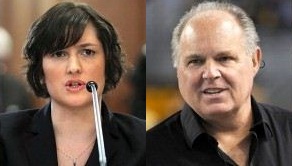
Sandra Fluke testifies - Rush Limbaugh pontificates
Here’s what I find interesting and new about all this. The conventional wisdom holds that this reaction would not have happened so quickly, or perhaps at all, without Social Media technology and ideology. Social Media (think Facebook and Twitter) is easily accessible and by its very nature incredibly scalable. This technology allowed the backlash to Limbaugh’s comments to spread like wildfire. In addition, the very nature of Social Media discourages anyone from standing idly by. Its ideology is interaction. All that was needed was for someone to bridge the gap between the echo chamber of Limbaugh’s loyal listeners to Limbaugh’s show and the larger echo chamber of offended netizens.
So, how far will the power of Social Media take this? It remains to be seen whether this controversy is just a bump in the road or sets a new precedent. To me it’s clearly a test case. Will Limbaugh weather this storm? Will a backlash to the backlash emerge as the dittoheads launch a counter offensive? What do you think?
————————
What I think about Rush Limbaugh’s comments themselves is secondary to my fascination in watching this thing play out. To me his comments bring to mind the Farmer and the Viper tale from Aesop’s Fables. Limbaugh is paid an exorbitant amount of money to say mean and outlandish things. Why is anyone surprised when he does?
In case you missed it, last Wednesday, February 29, 2012, Andrew Schiff at Euro Pacific Capital Inc. in New York got some unwanted attention. He was quoted in a Bloomberg article on reduced Wall Street bonuses saying his $350,000 salary just isn’t enough. “I feel stuck,” he told Bloomberg, “I wouldn’t want to whine. All I want is the stuff that I always thought, growing up, that successful parents had.” Judging from the thousands of comments to the Bloomberg article and the hundreds of postings it generated, many readers thought that he was indeed whining. (You can read the original article here: Wall Street Bonus Withdrawal Means Trading Aspen for Coupons)

Andrew Schiff, from the Euro Pacific Capital website.
Here’s the thing that caught my attention though, Andrew Schiff is the director of communications and marketing at Euro Pacific Capital. That means that part of his job is to talk with the press. Whether you are sympathetic to Schiff’s situation or ready to condemn him as “a poster child for greed and venality” you have to wonder, what the heck was he thinking? I have a good guess – at that moment he wasn’t. At least he certainly wasn’t following his Euro Pacific Capital talking points. He was just speaking for himself, isn’t that okay?
No, it isn’t okay. One of the first lessons you learn in PR 101 is if you don’t have anything to say, don’t say it. And I don’t mean the infamous “no comment” – don’t even say that (it sounds as if you have something to hide). Simply don’t volunteer your opinion in a public forum unless you have a specific goal in mind, i.e., some important information you want to convey. This may seem a heretical notion in our Reality TV culture, but “communications” is Schiff’s job. He can’t claim to be the latest Jersey Shore cast member. He also can’t claim ignorance of another in PR 101 basic lesson – you always represent your company and you’re never off the job. This goes for a drunken Apple employee at a bar as well as a Wall Street communications director stuck in traffic.
So, he screwed up. Happens to the best of us. Now what?
In the old days, before the ubiquitous growth of the internet and social media, one’s first inclination might be to let this die out naturally. Every story has a news cycle and this, left on its own, would seem to qualify as a one-day wonder. But unfortunately for Schiff, his quotes touched a nerve and the comments to the original article and the blogs, the Facebook posts, and the tweets they spawned took on a life of their own. For some, he suddenly became “a poster child for greed and venality” and for others a stalwart defender of the struggles of the 1%.
Schiff soon realized this story wasn’t going away and it was time for some damage control. This time he prepared his talking points and had something to say and he took some calls to tell his side of the story. On Friday NPR aired an interview and posted an accompanying article in which Schiff explains that he was just trying to say that the costs of living well in New York have soared beyond the reach of even the affluent; that the issue was the crazy costs of living and working in New York – not his income. And as someone who has a relatively modest bonus, one-sixth of his salary as opposed to the 80% many Wall Street workers receive, he shouldn’t have been included in the discussion at all. While his arguments may seem insufficient to those who have already made up their minds about him, Schiff did come across sympathetically. In hearing his voice, he became a real person, a compassionate character rather than a cartoon. So while it might have taken the director of communications and marketing at Euro Pacific Capital a couple of days to regain his footing, in the end, he did. I guess maybe he deserves his salary (and a bonus!) after all….
Today Microsoft is releasing the Windows 8 Consumer Preview. What a clever way to use the extra day we get to enjoy this leap year.
It’s free. Should you get it? If this is the first you’ve heard of it, no, probably not. It’s a beta or test (i.e., incomplete) version of the upcoming operating system (OS) which is still in production. Barring any unforeseen delays you’ll get a chance to see it on PCs at Costco before the end of the year. However, if you are still interested in being a guinea pig for Microsoft make sure to do a “clean install” on a spare, non-productivity PC. If you don’t have extra PCs lying around or are not sure how to do a clean install, my recommendation remains to sit this one out.
I’ll definitely give it a try for nostalgic reasons if nothing else. This is the first major OS release since Windows 95 that I haven’t been using many months before it was released. This is also the first Windows product launch in years that hasn’t been keeping me awake at night. That’s because I left Microsoft in 2009, last working on the lead up to the release of Windows 7. Since then I’ve been advising local startups on their public relations strategies and online media campaigns.
It’s an odd feeling not being intimately involved with the marketing communications work going into this product as it makes it way to the market. But having lived through it many times I can tell you what my former colleagues are going through. The MarComm team long ago defined their Marketing Objectives for this release. My bet is that it’s something along the lines of reestablishing PC relevance. From there they’ve created their Marketing Strategy by defining the Windows 8 Target and Positioning Segments. The Promotion (MarComm’s bailiwick amongst the 4 P’s of the Marketing Mix – see About MarCommMan) has already begun with, amongst other things, the release of the new Windows 8 logo design earlier this month.
The Windows 8 logo announced earlier this month.
Software developers and PC manufactures have been testing Windows 8 for many months, but the release of the “Consumer Preview” signals that Microsoft is on track to deliver the operating system to the PC makers. The OS has to be completed by early summer in order to have it available on new PCs in time for the back-to-school shopping this fall. This is the “death march” phase as the development team races to get the operating system done. We’ll see if they make it. But for the Microsoft marketing machine the execution phase of their multimillion dollar global campaign is just beginning. Let’s see how they do.

Windows 8 screenshot
And if you are a real geek check out Steven Sinofsky’s Building Windows 8 Blog (an MSDN site which requires a Live ID for login).
This weekend I read Social Media Judo, co-written by the partners of Ivy Worldwide, two of whom (Nick White & Chris Aarons) I know pretty well from my Microsoft days. In fact, the book opens with the saga of a rocky Windows Vista social media campaign which I remember with painful clarity. I was working in our Redmond, Washington offices on the Windows Vista PR team at the time, just a few doors down from Nick who was driving our blogger community efforts. But the reverberations were worldwide when the campaign “blew up in our faces” and the nascent Social Media community (circa 2006) roared to life with accusations of a sinister motives and pay-for-post bribery.
It was a learning experience for us all. For Nick, Chris and Geoff it eventually led to the creation of Ivy Worldwide, a company dedicated to doing social media right. For me it was a visceral lesson in Integrated Marketing Communications or more specifically, integrating Social Media throughout a MarComm campaign. Being physically close to the social media team doesn’t help if you don’t actually integrate with their efforts. In fact, our proximity at the time may have misled us into thinking we were working as a team. Now, whether I’m working with MarComm colleagues down the hall, or around the world, I make sure that we are truly coordinating our efforts.
To learn more about that initial Windows Vista social media campaign and the great things that grew from it, I recommend you get the book. It’s available in electronic and print versions on Amazon. At 167 pages it’s a quick and enjoyable read. The “Judo” in the book’s title refers to achieving the maximum effectiveness with the least amount of effort by using your opponent’s strength against them. Only in this case it’s really about using your partner’s strength for them. Having taken some Judo during my college days, enough to recall the moment when a throw felt effortless and powerful – and when it didn’t – I can relate to the primary analogy used throughout the book. And having worked with bloggers since before the term was invented, I can agree with the authors that these are the folks with whom you want to spend your time sparring.
You can find more detailed reviews of Social Media Judo online and Lockergnome recently published an interview with one of the authors, Chris Aarons, which provides a great overview. (http://www.lockergnome.com/social/2012/02/07/how-to-find-key-influencers/).

Social Media Judo
Last night on “The Colbert Report,” Stephen Colbert devoted the entire middle third, nearly seven minutes, to Wheat Thins. You can’t buy that kind of time and attention – at least not on purpose. The impetus was the Wheat Thins sponsorship of the show, or more specifically, the Nabisco brand memo which went along with that sponsorship. In sharing, and let’s face it, mercilessly mocking that memo, Colbert provided us with a glimpse behind the MarComm magic that typically accompanies a product sponsorship.
The memo was produced by Nabisco’s marketing communications department to help define the Wheat Thins brand. From the extensive excerpts shared by Colbert it was clearly meant as an internal document. MarComm professionals produce documents like to this help others (advertising agencies, graphic artists and illustrators, commercial writers and directors, etc.) correctly express their product attributes. Knowing that “Wheat Thins are not a crusader or rebel…” provides the guidance an illustrator needs to decide whether or not to add a bandana to the cartoon cracker character created for a website. It provides an advertising agency the background needed for the Don Drapers of the world to come up with the clever idea for a 60 second TV commercial (and the 30 second variation). Knowing how these things work, Nabisco likely had the opportunity to have a Wheat Thins product manager meet with some or all of Colbert’s 12-plus writers. This memo (along with lots of boxes of crackers) was the “leave behind.”
I experienced an odd sense of embarrassment and delight in watching the segment; I imagine the Nabisco folks felt the same. Clearly this was not the way they had imagined their sponsorship would play out. On the other hand, the crackers brand memo provided incredible grist for the comedy mill. Despite the mockery, Wheat Thins was talked about by Colbert for nearly a third of his show and by many others, in many ways, for many days thereafter (witness this blog post). The exposure of the mechanics behind the marketing campaign (like a magician explaining her tricks) resulted in the Wheat Thins brand attributes being laid bare. And while the memo excerpts were funny, they were in no way damning. In the end it was a minor coups for Nabisco, despite the embarrassing exposure of the over-the-top, inspirational language used by frustrated English majors in typical brand guideline memos (and yes, I’m one).

Stephen Colbert extols the virtues of Wheat Thins
Watch the original Wheat Thins segment here on the Colbert Nation website. It’s delicious!
Stephen Colbert, “Let me reiterate — I cannot say this too many times — that this is an actual memo from Wheat Thins that I received. And I just wanted to make sure you understood that before I informed you that [quoting from the memo] ‘Wheat Thins are not a crusader or rebel looking to change an individual’s path (or the world).’”
Last night’s CNN Republican debate in Arizona (dubbed by some “The Mudfight in Mesa”) ended with one final question put to each of the candidates, “What is the biggest misconception about you in the public debate?” Similar to the classic job interview question, “What’s your greatest weakness?” the question is designed to force a candidate to acknowledge a negative trait while offering the amusement of watching someone turn that same weakness into a strength (“People say I’m a perfectionist…”).
For these four extensively trained media spokesmen however it’s an opportunity to employ the ABC’s of media training. As the acronym indicates, ABC is one of the most basic lessons taught by public relations pros to spokespeople. When asked a question that looks like it will take you off message Acknowledge it, Bridge back to your message, and regain Control of the conversation.
Coming at the close of what might be the final Republican debate before a key series of primaries, John King, the CNN moderator, could have asked, “So, in summary, what makes you the most qualified to be the next president of the United Sates?” In fact, it doesn’t matter whether John King asked this question or not, this was the question the candidates needed to answer. It was their opportunity to summarize what makes them the voters’ best choice.
So how did the candidates do? Ron Paul answered that the biggest misconception about him was that he couldn’t win, ignoring the ABC’s and answering the question posed. In Paul’s case this is a fine answer because it reinforces his image as no-nonsense straight shooter (and because he indeed can’t win). Rick Santorum replied similarly but deftly applied the ABC’s and bridged to his talking points as the only true conservative choice. Newt Gingrich applied the ABC’s without answering the question by stressing “the one thing” that he wanted voters to know about him was the amount of work it took for him to achieve his many accomplishments. This wasn’t an acknowledgement of any public misconception, but it kind of sounded like it and was a logical enough bridge that the audience (and the moderator) went along with it.
Mitt Romney, on the other hand, neither minded his ABCs like Santorum and Gingrich nor answered the question like Paul. Instead he skipped the A and B and went straight to the C in an attempt to summarize why he would make the best president. It was so jarring that the moderator attempted to bring him back to the question about perceived misconceptions, to which Romney replied, “You know, you get to ask the questions you want, I get to give the answers I want.”
Some commentators hailed Romney for not allowing himself to be bullied. Others admonished him for avoiding the question. But the real issue is that in forgetting his ABCs, Romney let the question get all the attention when it’s the answer that really matters.
————————————————————————
JOHN KING, CNN: Governor Romney?
MITT ROMNEY: We’ve got to restore America’s promise in this country, where people know that with hard work and education that they’re going to be secure and prosperous and that their kids will have a brighter future than they’ve had. For that to happen we’re going to have to have dramatic fundamental change in Washington, D.C. We’re going to have to create more jobs, have less debt, and shrink the size of government. I’m the only person in this race…

Mitt Romney forgets his ABCs at the February 22, 2012 CNN Arizona Republican debate.
KING: Is there a misconception about you? The question is the misconception.
ROMNEY: You know, you get to ask the questions you want, I get to give the answers I want.
KING: Fair enough.

May flights of angels sing thee to thy rest. Murdock Laemmel – February 26, 1996 to September 19, 2010
My dog was a terrific sleeper. He wasn’t much of a retriever or a swimmer, but he was a terrific sleeper. He would jump up on my bed, take a quick survey of the rumpled terrain, bunch the comforter into a comfy pile, and plop himself down, settling in to an instant slumber. There he would lie, a self-warming water bottle, breathing rhythmically, snug at my feet. Enough to lull even a guilty insomniac to the restful sleep of the innocent.
We weren’t looking for a great sleeper when we found him, just lucky I guess. As far as my daughter was concerned we were looking for pretty much any dog. I was somewhat more discerning. I wanted a dog that was not too big, but not too small. Not too young (that we would have to train him) but not too old (that we would have to maintain him). Not too energetic, that we would have to run him three times a day, but not too lazy that we would be tempted to skip regular walks (for our own health and sanity). Not too aggressive, but not too meek. Not too common a breed, but not too exotic either. You get the idea. I wanted a particular dog. A dog I hadn’t met yet.
We found our dog not long after my daughter’s 8th birthday, at which point (according to her) she had been begging for 9 long years. Since her conception apparently. I wasn’t so easily won over because I didn’t have a dog growing up, didn’t have any pets at all actually, and a series of sadistic dog-owning neighbors had instilled in me a lifelong uneasiness about canine creatures. I wouldn’t go so far as to say that I was afraid of dogs – though many who knew me would. They’d be wrong. The truth is that I liked dogs; I was just convinced that they didn’t like me. So I avoided contact with them by training myself to pick up the delicate clinking of their metal dog tags from vast distances, so as to provide some advanced warning. I’m serious. It’s a sound that stands out for me to this day. In using their second most sensitive sense against them I managed to avoid many dog encounters before they could occur. Of course this meant I was easy prey for collarless dogs, but one seldom encounters them on the mean streets of suburbia. Over the years I got to know many dogs deliberately encountered, introduced by their masters at play dates or by non-sadistic neighbors. And we got along fabulously. But I remained weary until well into my adulthood. That is, until we met Murdock and I became a dog owner myself. In fact, my years with Murdock made me so confident that not long ago I actually broke up a vicious fight between two large and misguided retrievers. I emerged a bit shaken but unscathed. The dogs exchanged puncture wounds on the face and neck and both felt quite sheepish about it afterwards. But I digress.
Murdock was named after the crazy but lovable pilot in the original A-Team TV series. We didn’t name him, but soon saw that the name fit. He was fearless and loyal, and a bit nuts. We adopted him from a couple that said they had to give him up because he wasn’t getting enough attention or exercise. He was already 8 years old, well into middle age in dog years. In human years he was the same age as my daughter when we took him for a trial stroll around the grounds of the public library. I wasn’t sure what the real story was behind this couple offering up Murdock – a member of their family – for adoption. But now I can see that there comes a time when you have to make the decision of what’s best for your pet and the details aren’t really important. The couple had adopted him themselves as a puppy from a Brittany rescue agency. He was turned in because he had broken his front leg. The woman told us the story of how their original owners dropped the puppy while trying to load him onto a boat for a lake cruise. The result was a broken leg, so they returned him because he’d never be “right again” after that. She told the story as if she had witnessed the horror in person, with the resentment of a mother feeling the sting of her child’s rejection. The child she was now giving up for adoption.
So this is how we learned that Murdock was a pure bred Brittany, perhaps the runt of the litter as he was a bit small for his breed, tipping the scales at just under 35 pounds. Hearing incorrectly, and not knowing much about dogs, I thought at first that his name was “Britney” as in Britney Spears. No, no, his name is Murdock and he is a Brittany. He’s a boy! Oh, of course, that’s what that is down there… So I did a bit of research on Brittanys. They get their name from the Brittany region of France and are depicted “on the hunt” in paintings and tapestries from the 17th century. Commonly called gun dogs, they are working/utility dogs that can do it all; serving as pointers as well as hardy retrievers. Reserved barkers, Brittanys are typically orange or “liver” and white or roan colored. Murdock was mostly white with orange spots and orange ears with a white wishbone pattern on his forehead. Bred to an optimum size-to-strength ratio Brittanys are not so big as to unduly disturb the underbrush when on the hunt or require too much care and feeding, yet they have the strength and endurance for long pursuits. A website with advice on choosing dogs describes the breed in this way: “Typically quite athletic, compact, and solidly built without being heavy, their expressions are usually of intelligence, vigor, and alertness. Their gait is elastic, long, and free. Noted for being easy to train and sweet-natured. The breed is generally more sensitive to commands than other hunting breeds, and harsh corrections are often unnecessary. Brittanys are all around sound dogs, as they are excellent family pets as well as working dogs in the field.”
They are not a frequently seen breed nowadays. Golden and Labrador Retrievers are far more common. A little research reveals that the Brittany just squeaks in at the bottom of the list, at number 30, in the American Kennel Club (AKA) registrations for 2008. The remarks I would most often hear when the breed was recognized were, “Oh, my grandfather had a Brittany!” or from an older woman, “We had a Brittany when I was growing up!” or from a southerner, “My dad has a Brittany for hunting back at our farm in Georgia!”
There was some dispute as to Murdock’s age and birth date. If indeed purebred no one had bothered to keep proper papers. According to his veterinary records he was either born in April 1995 or February 1996 and was either 7 or 8 years old when we adopted him seven (or eight) years ago. He looked good though, and like his new master (I’d like to think) he had a dignified royal European bearing and for a long time defied his years. People would meet us on walks and think he was a puppy. He wasn’t a runner, but he could walk all day. I took him on some major hikes – even some overnight camping trips, each of us wearing backpacks – and we could conquer mountains. He’d sleep the whole drive home, a rest well deserved, his white fur caked with dust and his tummy (which had no fur) still pink with exertion.
Did I say I was his master? Only at times. I shared that honor with my daughter. She finally got the dog that she had begged for since conception. He was hers too. There’s a photo of the two of them in the tall grass not far from our house which captures Murdock in his prime and my daughter in her innocence. A girl and her dog: pure, requited love.
We were never a “dogs off the furniture!” kind of household, which was a good thing because Murdock loved to jump up on a bed, or a couch, or a chair to take a nap. Any place that was more comfortable than a cold hard floor. On the nights when my daughter and I were both home Murdock would make the trip from room to room, spending a couple of hours with her, then a couple of hours with me. Once, when Murdock was still young and agile, I had rearranged the furniture in my bedroom earlier in the day, reorienting the bed from due north to due east. The bed frame is about 4 feet high at the foot, while just a foot or two at the sides. I hadn’t considered that this would cause a problem for Murdock in his middle of the night commuting, but apparently he’s a creature of habit. Imagine my – and Murdock’s – surprise when, as I lie deep in blissful slumber, a 35 lb Brittany came flying over the four foot high wall at the foot of my bed. We were both wide awake after that.
Murdock was a lover, not a fighter, and most of the time he was pretty even keeled. But he could get feisty. When we first got him he would love to play a rambunctious tug of war. And he was hardwired to take off after squirrels and rabbits – though he never got close to catching one. Once, when we were visited by trashcan raiding raccoons in the middle of the night I sent him out to chase them off and then immediately regretted my careless decision. Those raccoons had vicious jaws and claws! Luckily they decided that discretion was the better part of valor and jumped the fence rather than turn and fight. Another time we were walking around the lake, as always off-leash because Murdock was a rebel at heart, and he wandered into the tall grass by the water’s edge. I lost sight of him and kept walking. In the distance I heard a yelp and then, like a wet bat out of hell, Murdock came tearing down the path. Despite his webbed feet he was never much for swimming, so I can only surmise that a frog must have pushed him in. At some point we stopped going to dog parks because Murdock would attempt “relations” with any breed, any size and any sex dog that would allow it – this despite the fact that he had been neutered many years before. You just can’t keep a good man down.
Eventually the years caught up with Murdock. His nightly commutes between my daughter’s bedroom and mine morphed into a “zone strategy” where he would pick a neutral middle ground and camp out hoping it would be sufficient to catch either of us if we should stir. Despite being ravenously hungry and a shameless beggar he began to lose weight even after we began to be more generous with his snacks. His daily allergy pills and monthly allergy “cocktail” injections became less important as we stopped taking the long walks that exposed him to his great nemeses: pollinating grass, elder trees and cat dander. In their place he started taking medicines to ease the burden on his enlarged heart, ACE inhibitors to relax his blood vessels by reducing the enzyme which tightens them and an inotropic agent which stimulated the dilation of his arteries. A diuretic was added to remove fluids and further relieve the pressure on his heart. When, despite all these medications, he began to cough and wheeze as his enlarged heart pressed against his esophagus, we added Hydrocone, a cough suppressant and opiate/narcotic. To top it off, we put ointment on his dry, flakey nose. None of these medications did anything for the cataracts that dimmed his vision and the arthritis that made him move so gingerly in the mornings.
Towards the end there were a lot of pills, a different mix for morning, noon and night. At times he seemed to be as happy and healthy as when we first met – the medications doing their job. At other times the same mix of medications – perhaps even a little bit more here or there – seemed to have no effect whatsoever. He would cough and pant deeply, expelling the darkest, dankest air from the bottom of his lungs. Like the air from a crypt tinged with pungent odors from his weakness for coprophagia (look it up). And from the other side would emanate noxious swamp gasses that could suddenly fill an entire room – the classic “silent but deadly.” He definitely made his presence known. There were times quite frankly, towards the end, when Murdock was simply not fun to be around. His coughing (which sounded like honking) may or may not have been painful to him, but it was excruciating for me to endure. Having started down the slippery slope of trying to fix his issues as they emerged we were conscious of retaining Murdock’s dignity and our sanity. Yes, with careful adjustment of his medications and regular monitoring of his condition with x-rays and ultrasounds he might well have lasted another year. But Murdock was no longer walking between his masters bedrooms at night, no longer playing tug-of-war and there were no more leash-less walks around the lake where the frogs were waiting for their chance to push him in. He would no longer meet me at the door when I came home. He was sleeping more and more, as if building up his stamina for the next long sleep.
It was somehow fitting that Murdock had an enlarged heart. In his case it was both literal and figurative. Never one to wander far from me or my daughter, as he got sicker he stayed even closer. Even when napping – which was most of the time towards the end – he would wake up to walk into the next room so that he could lie down again and nap closer to you. My daughter has spent half her life with Murdock. And in turn he has spent half of his life – probably the only life he could ever remember, with her. In his last year I spent a great deal of time alone at home with him, more than I had in any of the previous years. I think that comforted him. Dogs, like people, are social animals and he got to spend an awful lot of time with the leader of the pack. As a result I’d grown so used to his company that I feel his presence now whenever I am at home. And perhaps that is as it should be. Perhaps he is here, watching over me and my daughter. Or maybe he is sleeping his deep sleep of the innocents, secure in knowing that we are watching over him and that he is safe and warm and protected. Forever. We love you Murdock. Good bye.
Now cracks a noble heart. Good-night, sweet prince; And flights of angels sing thee to thy rest.
Hamlet, Act V Scene II (spoken by Horatio upon Hamlet’s death)

Rebecca and Murdock – Larson Lake, Blueberry Fields (Bellevue, Washington)
Click on this link to view the Reviewer’s Guide I wrote and produced: Windows Live OneCare Reviewer’s Guide –
For proper PC care, most consumers need more than just anti-virus software. Although such protection is clearly a must-have, electronic assets such as digital photos, music and financial data must also be protected. Furthermore, today people are putting more “miles” on their PCs, which can lead to system clutter and performance degradation. And with multi-PC homes and wireless networks becoming mainstream, consumers must deal with the additional complexity of things such as printer sharing and network security.
Windows Live One Care
For the typical consumer this can present a huge challenge. But consumers do not want to deal with a disparate mix of products that must be purchased, installed and maintained; instead, they just want their PCs to work, which means they want the following:
- Software to help protect them from viruses and other threats.
- A PC that consistently runs quickly and efficiently.
- Protection of valuable data, regardless of its format or location.
- Simple instructions when user action is required.
These issues have reached a new level of complexity now that many homes — and virtually all small businesses — have more than one PC, as well as some sort of network. This added complexity poses entirely new challenges, prompting questions such as “How do I consistently manage all my PCs?” and “How do I make sure my wireless network is properly secured?”
Designed for the nontechnical home, home office or small-business user, Windows Live™ OneCare™ 2.0 is an end-to-end PC care service that goes beyond comprehensive malware protection to eliminate the complexity in backing up files, tuning up PCs and managing a network.
The Windows Live OneCare Reviewer’s Guide and the application is now retried.
 marcommman