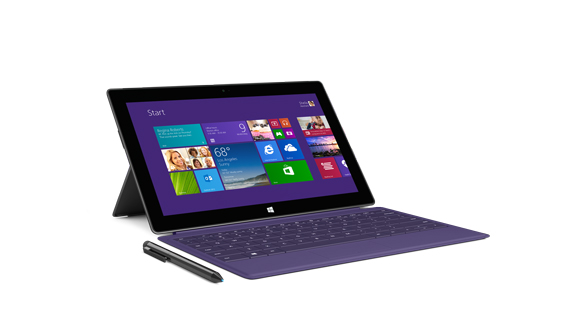
Surface Pro 2 – portability and simplicity of a tablet with the power and flexibility of a laptop.
Best of both worlds, or a “mullet”?
Me, I’m comfortable with blurred lines. I know I want it. It’s happening with my smartphone and my tablet. Not to mention my TV, gaming consoles and service providers. I want to drive a crossover (CUV) to go hiking during the day and then run it through the car wash and go to a fancy dinner that evening. I realize that a perfect balance of fun and functionality isn’t always attainable; otherwise we’d all be sporting mullets (business up front, party in the back!) but I’m willing to give it a try (the productivity tablet, not the hairstyle).
In June 2012 I wrote about the surprise unveiling of Microsoft’s first generation Surface convertible PCs/tablets. A few months later, at the launch of Windows 8, I discussed whether it was time buy a new PC with my decisive Yes, No and Maybe post. Today, Microsoft announced the impending release of its second generation Surface 2 and Surface Pro 2. In short, there’s no major change in Microsoft’s Surface strategy or direction and the improvements are in the Olympic tradition of “Citius, Altius, Fortius” – better, lighter, sturdier, faster, longer (lasting battery…). Also, a nice collection of accessories and value-added services were announced.
Like the first generation Surfaces, the Surface 2 is a “productivity tablet” (think iPad with an optional keyboard and Microsoft Office – but built on the Windows platform). Surface 2 is designed to only run applications built specifically for it and similar devices from a handful of other manufacturers. The Surface Pro 2 (note the addition of the word “Pro”) looks pretty similar but is a full-fledged PC in the form of a tablet. The Surface Pro supports existing Windows software and the ability to work in the familiar “desktop mode.”
More than a year since the original Surface launch the names and concepts may remain a bit confusing to some because we are still working through the awkward “convergence” years. Personally I’m comfortable with this ambiguity. Others, not so much. Will Oremus writes in Slate that Microsoft has created Surface 2 “[for] people who hate fun” and condemns both the products and the company for attempting to bridge the gap between work and play. The article cites a Statista chart that shows tablet owners spending 50% of their time doing entertainment things (games, reading, music, photos), 26% communications (email), but only 15% on productivity (writing) and 9% finding information (weather, news, product searches). I’d argue that at least half those things are indeed “productivity” – which at least makes it a tie. And on some days it may be well more than half. Reading a blog post is entertainment until you decide to whip out your keyboard and write a rebuttal. Then it’s all business. Watching a movie on a cross country flight is a great escape, especially if you can weed through some of your email before, during or after.
The blurring of the lines between work and play isn’t cognitive dissonance, it’s common sense. Bring it on. You know I want it!

A screenshot from Microsoft’s “A Fly on the Wall in Cupertino” short-lived video campaign.
“[This] was intended to be a light-hearted poke at our friends from Cupertino. But it was off the mark, and we’ve decided to pull it down.” Microsoft Corp.
I can’t tell you how many times I’ve been involved in marketing discussions where “create a viral video” was casually added to the project list. It always reminds me of an old Steve Martin joke that starts out something like, “I can show you how to make $1 million and pay no taxes! First, make a million dollars, then…” Wait a second buddy, what was that first step again?..
Creating a viral video is not unlike catching lightning in a jar – there are some basic rules. First, wear plenty of protective clothing. Then, like Steve Martin’s million, came up with an incredible idea. It has to be memorable, better yet, unforgettable. If not, it should at least be funny. It also has to get to the point within seconds and feel authentic, “real” in the sense that you are not trying to trick the viewer. The production itself doesn’t have to be complex, in fact, simple and straightforward is usually best.
The videos that Microsoft posted today (Friday the 13th, yikes!), and abruptly deleted about three hours later, were clearly designed to “go viral.” The campaign looked to be a quick and dirty response to Apple’s iPhone 5s and 5c announcements earlier in the week. In a series of short videos entitled, “A Fly on the Wall in Cupertino,” imaginary Apple employees are depicted selling the Senior VP of Design, Sir Jony Ive, and CEO, Tim Cook (both shown from the back) on the newest iPhone innovations. I thought the videos were mildly amusing, but I have to admit to some confusion – was one of those execs supposed to be Steve Jobs? Shown from behind with thinning dark hair, wearing a trademark dark sweatshirt, and (sorry to whoever stood in for the role) looking rather gaunt and sickly, it certainly could have been. On my second viewing, I clearly heard him referred to as “T” – indicating that he was supposed to be Tim Cook. Steve Jobs died nearly two years ago, so unless they were pitching these ideas to him in heaven it wouldn’t make much sense. But no less a bastion of journalistic integrity than the NY Daily News mistook him for Steve Jobs as did many others judging from comments posted online. Given that impression, I can see why some netizens considered the parody in bad taste.
In my view, this is the reason the ads were so poorly received. Yes, it would have helped if they were funnier, but this element of chicanery tainted the message and violated one of the basic rules of viral videos. No, not the one about wearing protective clothing; the rule about being authentic and “honest/real” with your viewers. Add to that the notorious loyalty of the Apple fan base and Microsoft’s “head fake” went too far.
Knowing the people involved in creating, or at least at some point approving, this campaign I am inclined to give Microsoft the benefit of the doubt here. They were trying for an approximation of the back of Tim Cook’s head. But I can see why many people thought that Microsoft was at best being deliberately ambiguous; and at worst being downright nasty.
The irony of course is that in the end Microsoft created a viral phenomenon today and these videos will probably be viewed more than they could have hoped for. Removing them from the official Microsoft YouTube site and Facebook page cuts off a large potential audience, but “truth will out” (The Merchant of Venice, Act II, Scene ii) and those clever enough (like you) may be able to find them mirrored elsewhere as the internet is forever.
————————————————-
Pictures speak louder than words. The man in the middle was identified in the video as “T” – indicating he was supposed to be Tim Cook. You decide. On the left is a photo of Jobs. On the right is a photo of the current Apple CEO, Cook. The back of whose head is in the middle?
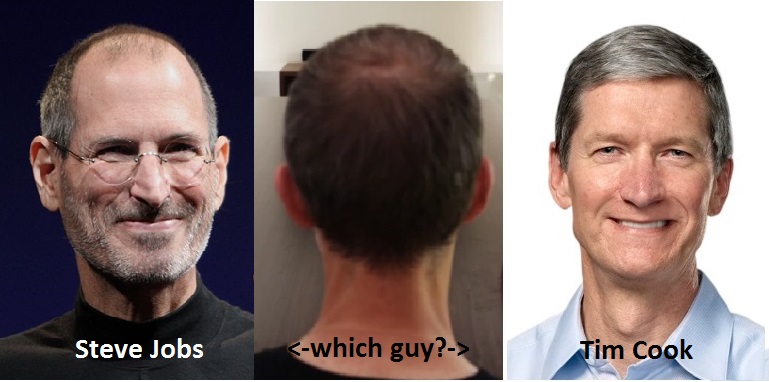
Steve Jobs and Tim Cook photos are from the Apple website. The guy in the middle is a screenshot from the Microsoft “A Fly on the Wall in Cupertino” video.
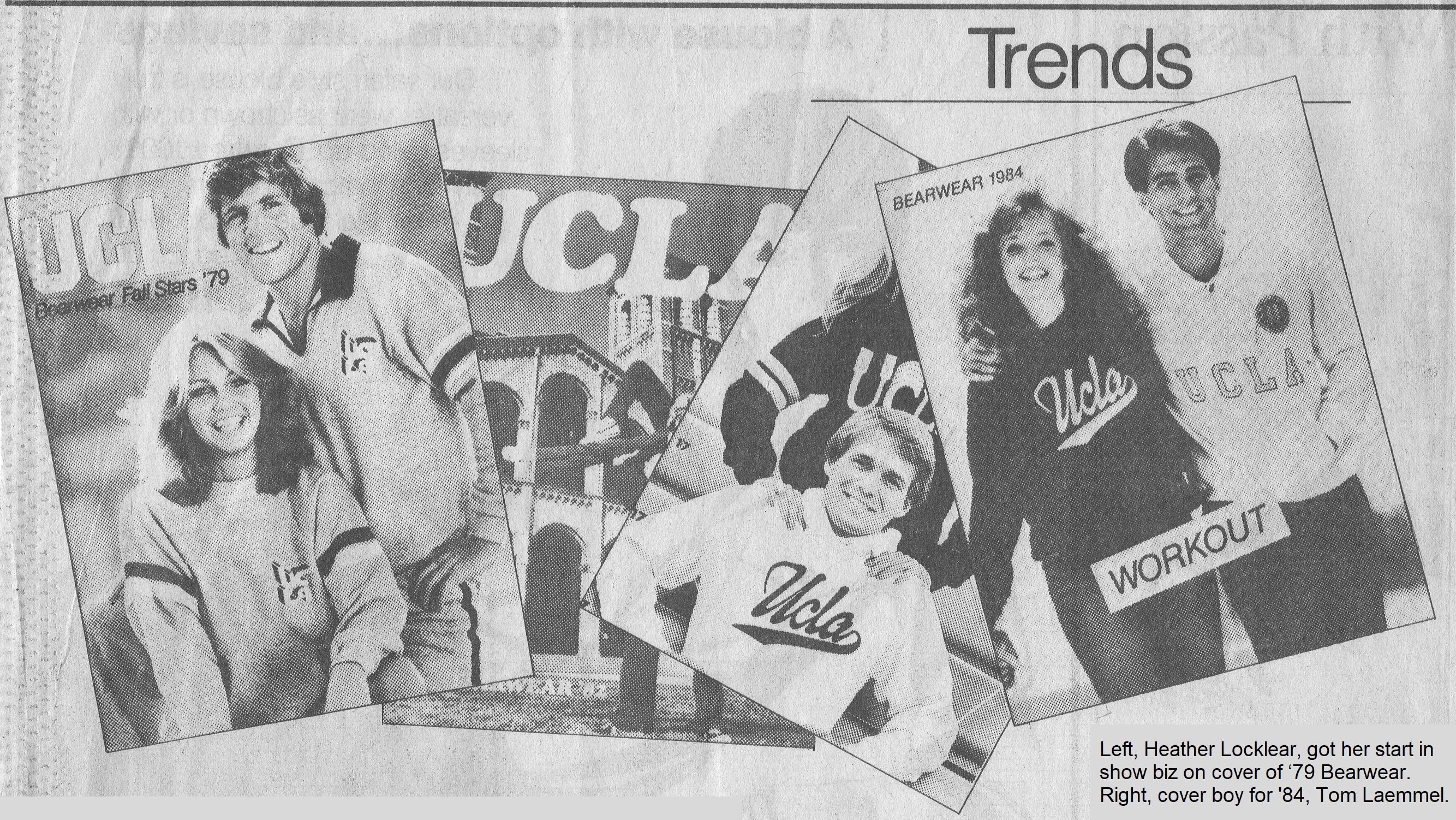
Thirty years ago today, the Los Angeles Times published an article about the UCLA Bearwear clothing catalog and this year’s crop of student models. I was fortunate enough to be amongst them.
If thirty years ago seems like ancient history, you’re wrong! As far as I was concerned, in 1983 I was already living in the future. The real 1984 was just around the corner, no longer an arbitrary date picked by Orwell for his novel about a dystopian future. (Or, maybe not so arbitrary, as it was written in 1948.) Los Angeles was abuzz with preparations for next summer’s Olympics and things were already being moved into place for UCLA to host half the world’s athletes in a campus-based Olympic Village. (I ended up working there – but that’s a story for another time.)
Ronald Reagan was in the White House, MTV was playing music videos 24/7, Sally Ride went to space, and I was debating whether to invest in the cool new “luggable” Commodore 64 computer or continue begging time on the Graduate Student Union’s multi-terminal Wang 2200 LVP wordprocessor. (I held off -purchasing a Macintosh Plus in early ‘86.) So, you see, it was modern times!
On the other hand, this sounds like a long time ago: 1983 was also the year that the first cellular phone call was placed and the year that the Internet was born (with the migration to TCP/IP from the US Defense Department’s ARPANET.) But I was unaware of these things at the time, and if I were, their significance would have escaped me. (Meanwhile, have you heard of Deep learning and Generative AI?)
The important thing about all of this is, of course, that per the LA Times, I was the “cover boy” following in the footsteps of “cover girl” Heather Locklear who had appeared on the 1979 UCLA Bearwear catalog cover. Within just a few years Heather, my fellow UCLA and Bearwear alum, had built an impressive career with roles on Dynasty and T.J. Hooker. If you want to know more, read the article!
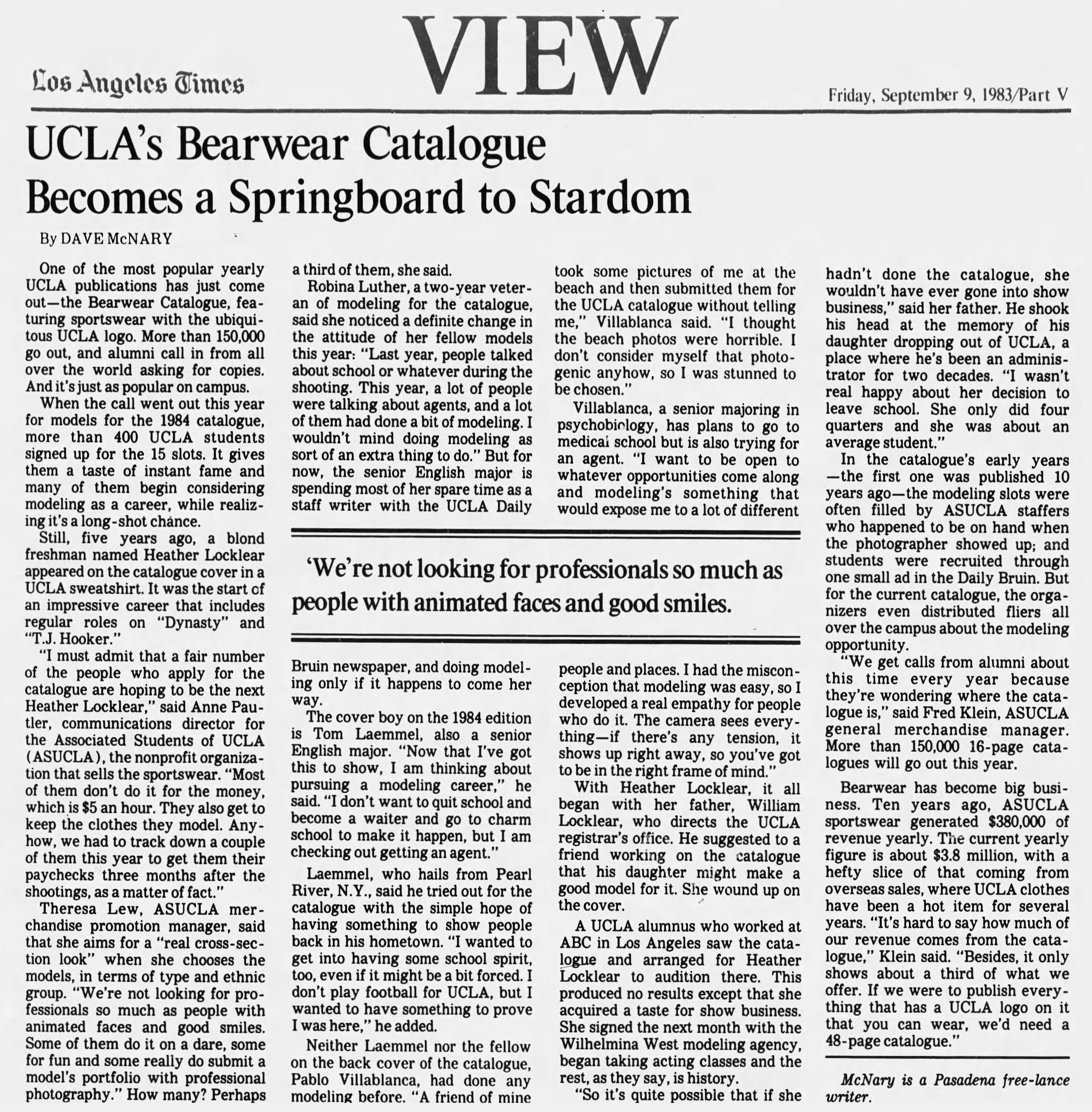
PS – I never put my heart into pursuing a modeling career. Truth is, that like Heather Locklear, if you catch the bug, you really do need to “quit school and become a waiter and go to charm school to make it happen” — quoting something I read in the LA Times. I quickly lost track of my fellow catalog models, but the Internet (thanks 1983!) tells me that Juan Pablo Villablanca, the back cover model mentioned just after the front cover model in the article above, pursued his plans of going to medical school and is now Chief of Diagnostic Neuroradiology at UCLA. Good going Juan Pablo. You see, that’s where an animated face and a good smile can get you!
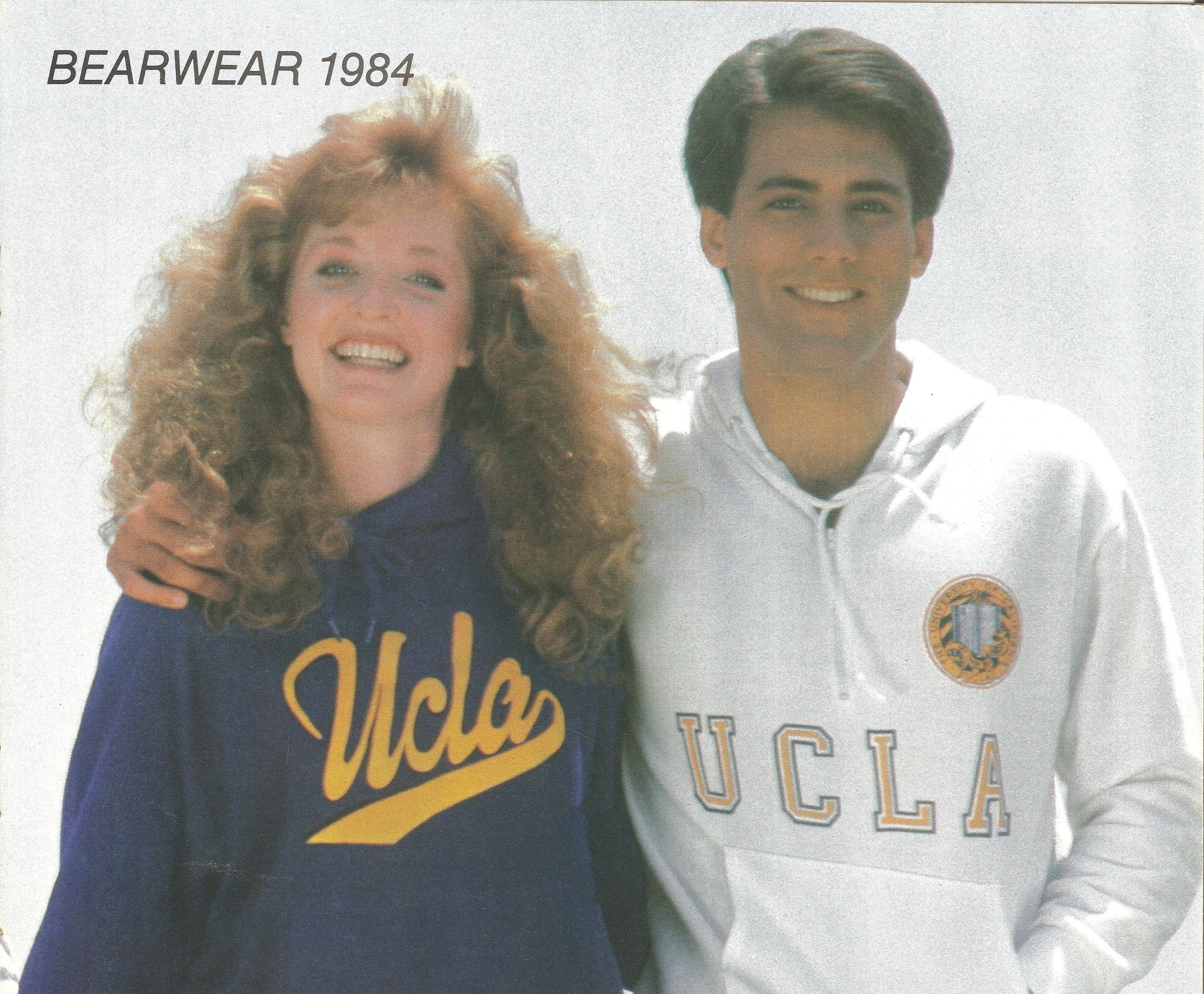
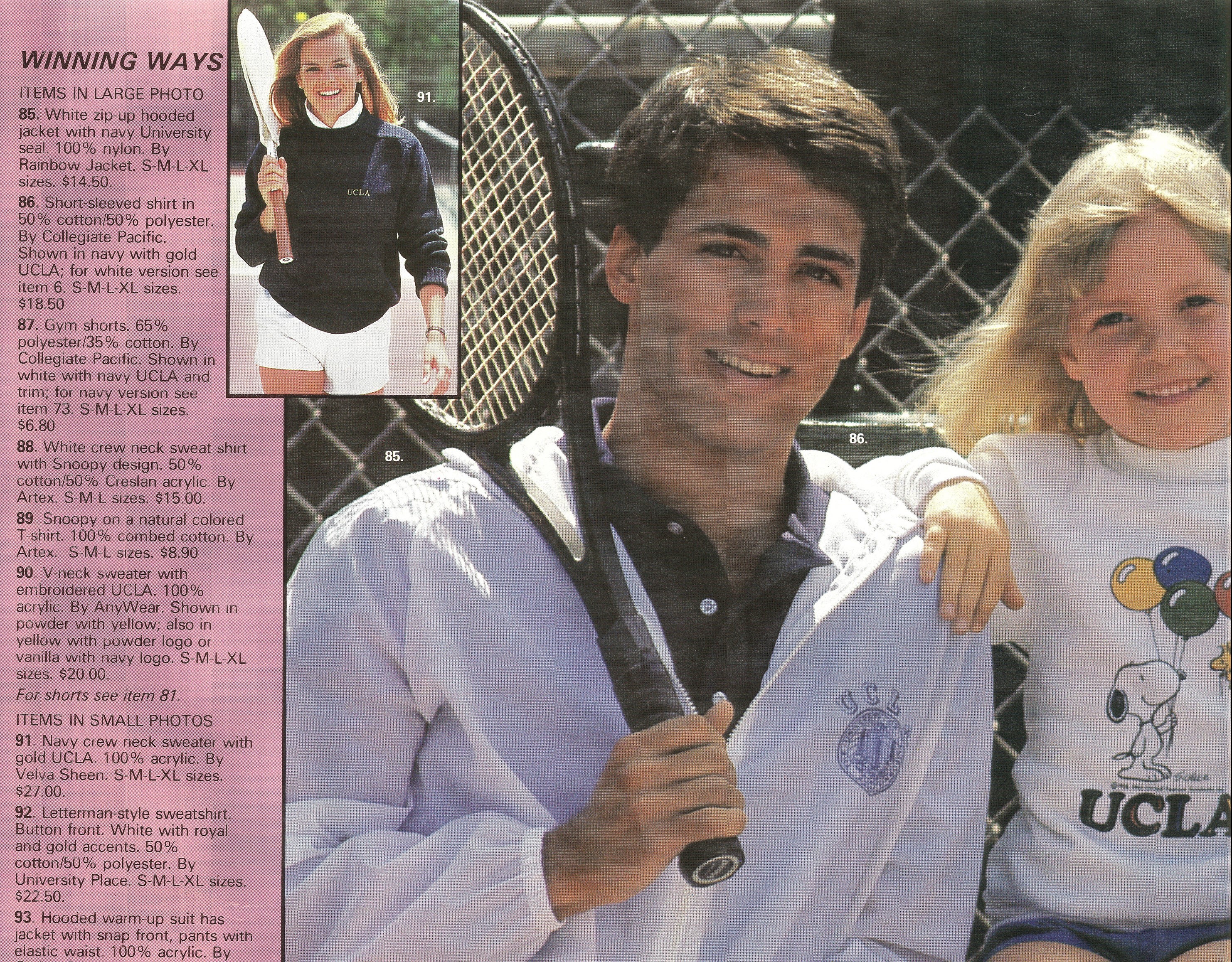
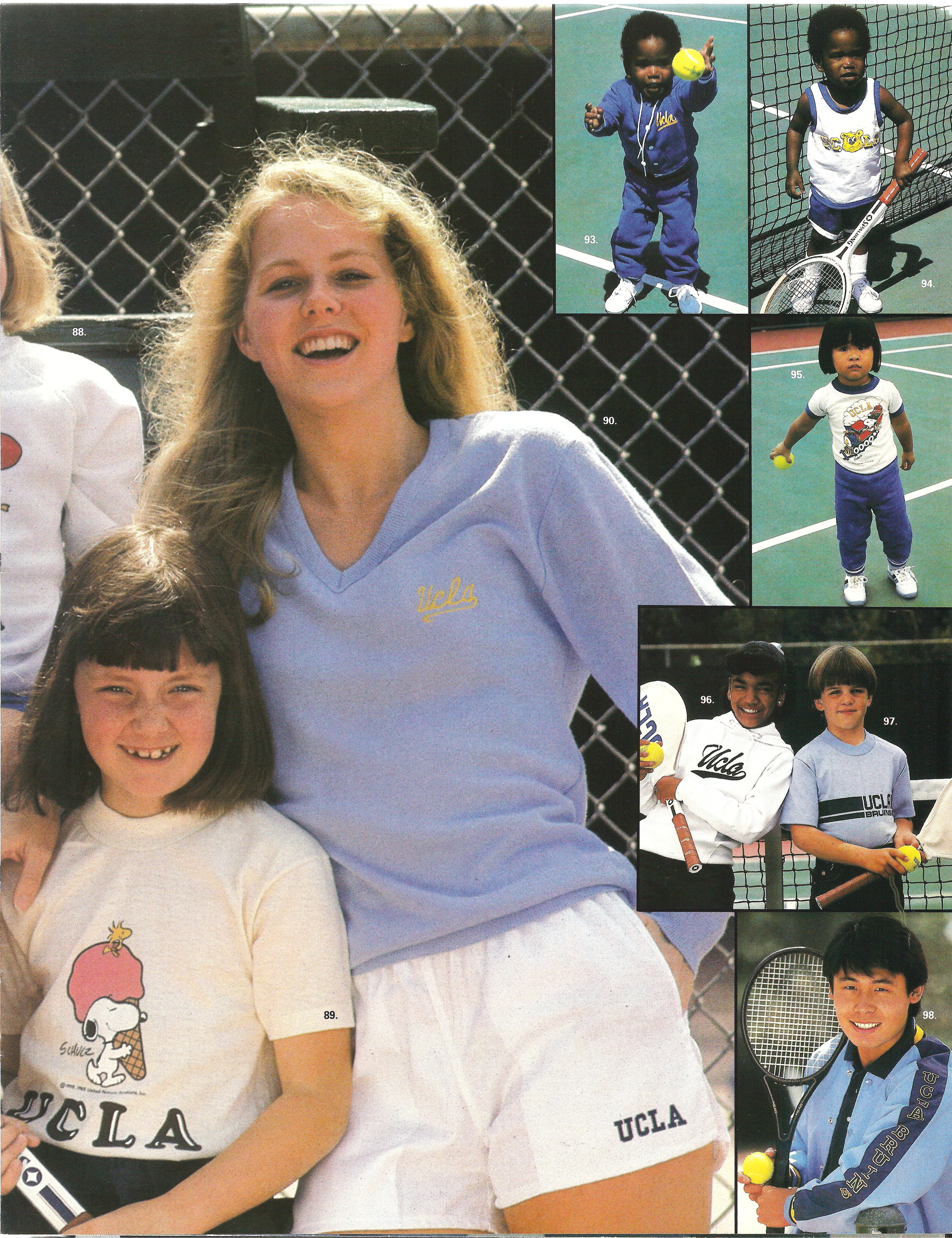
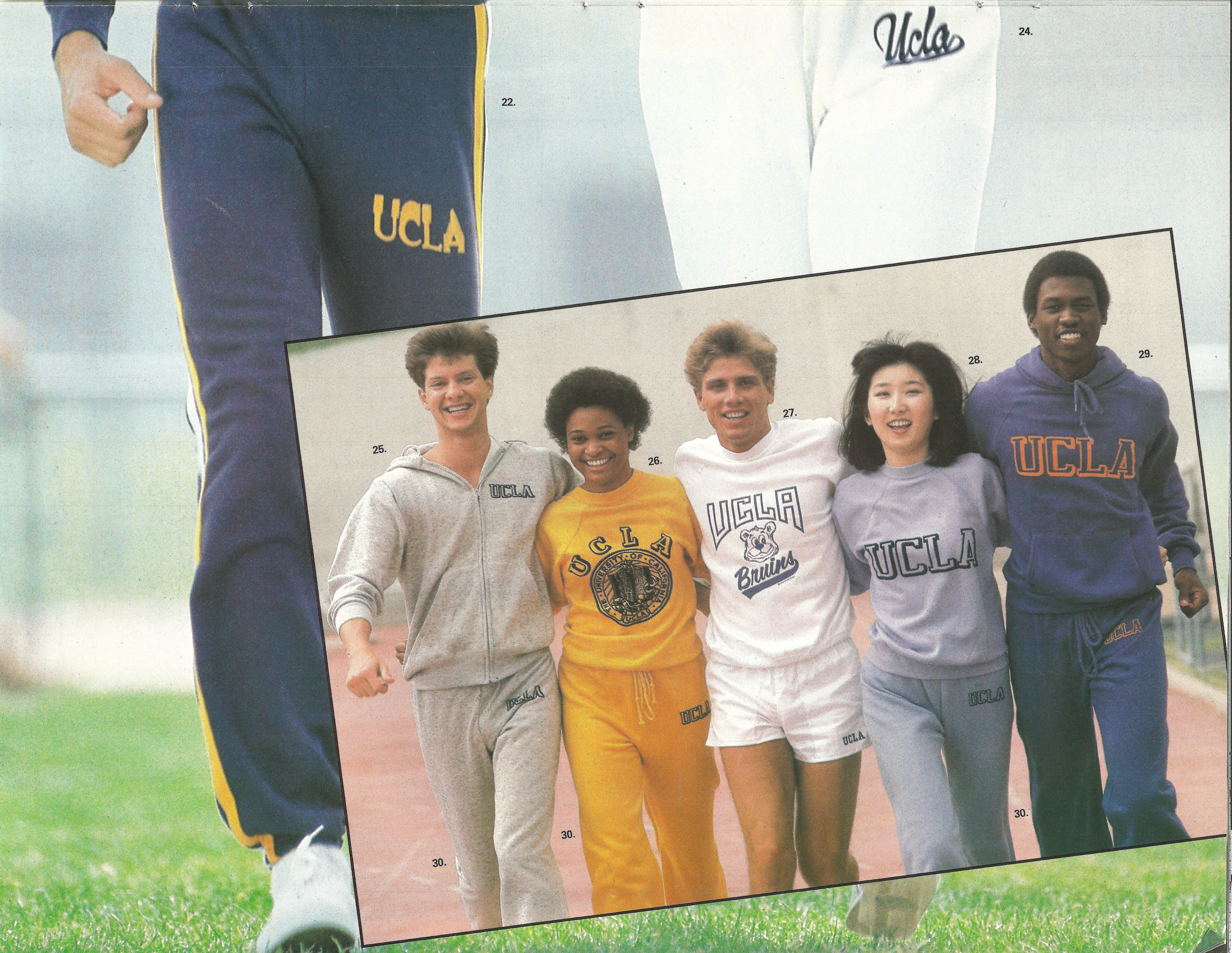
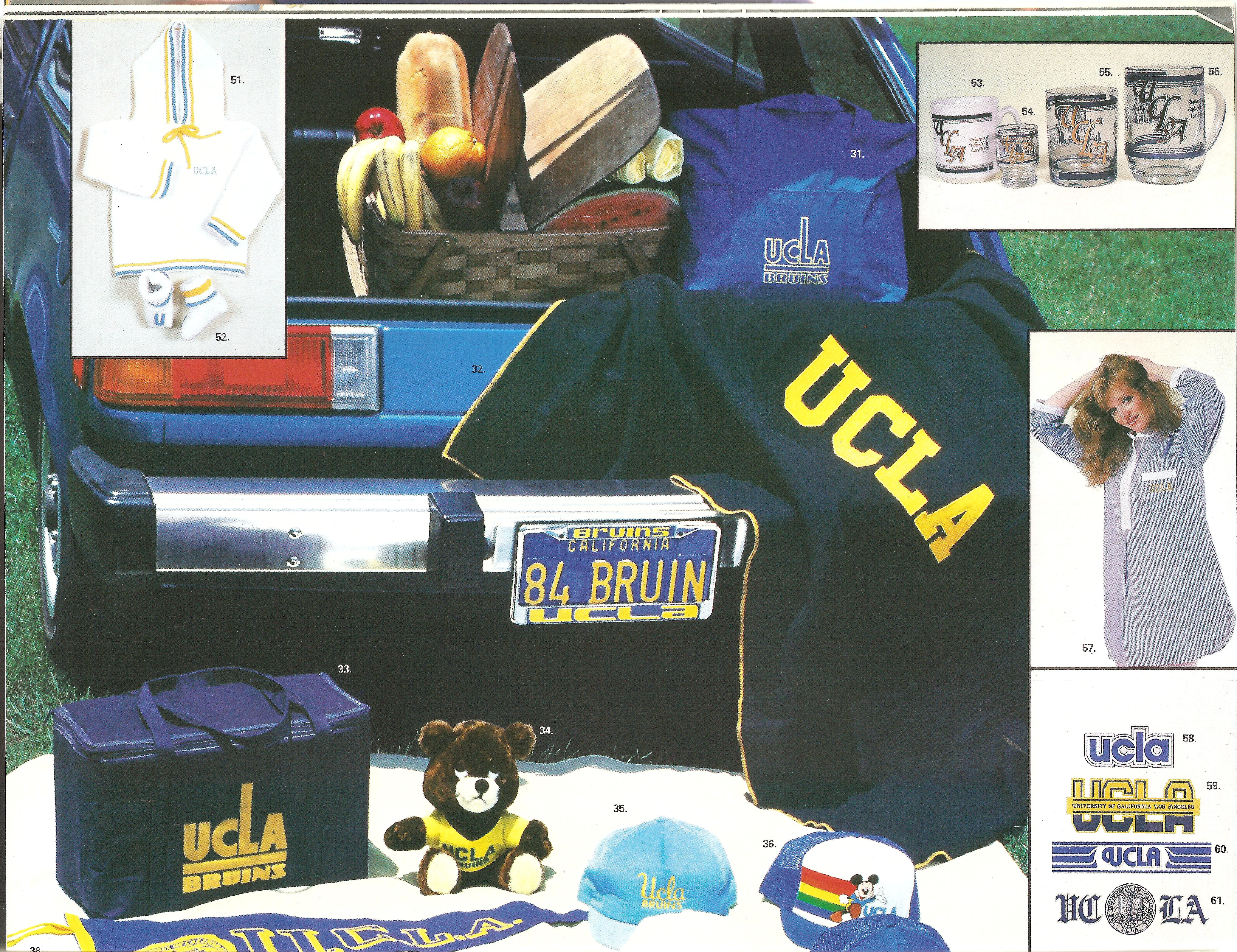
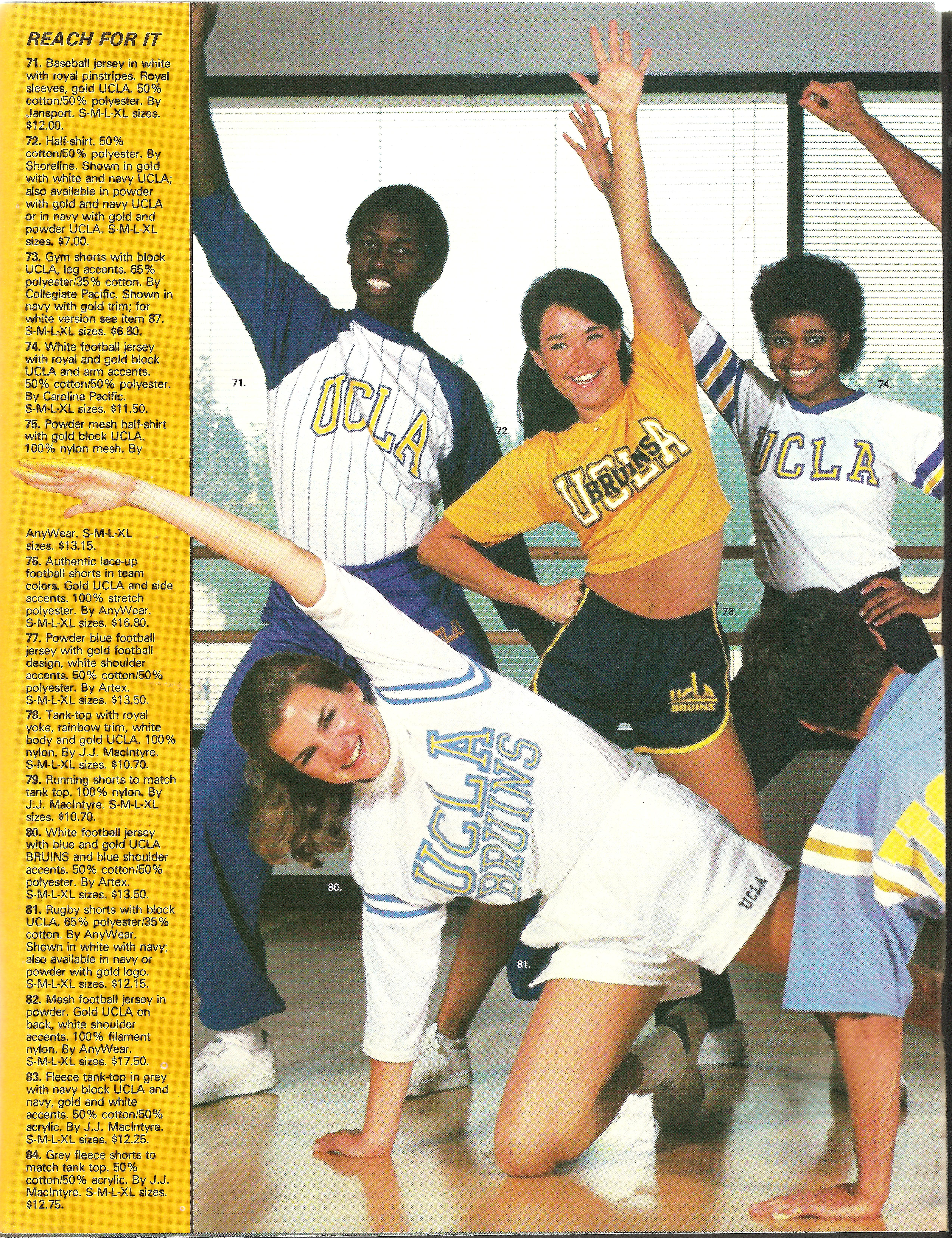
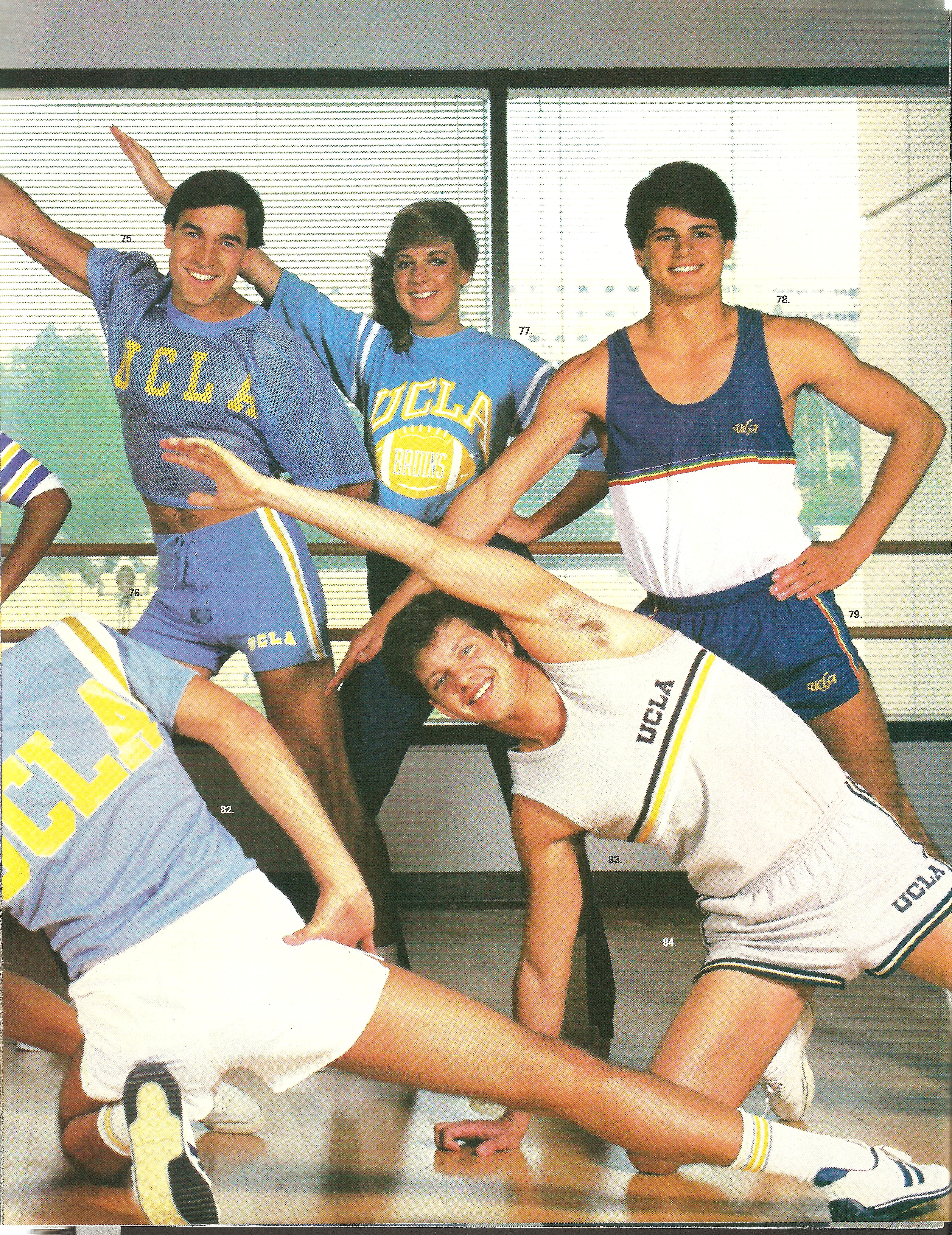
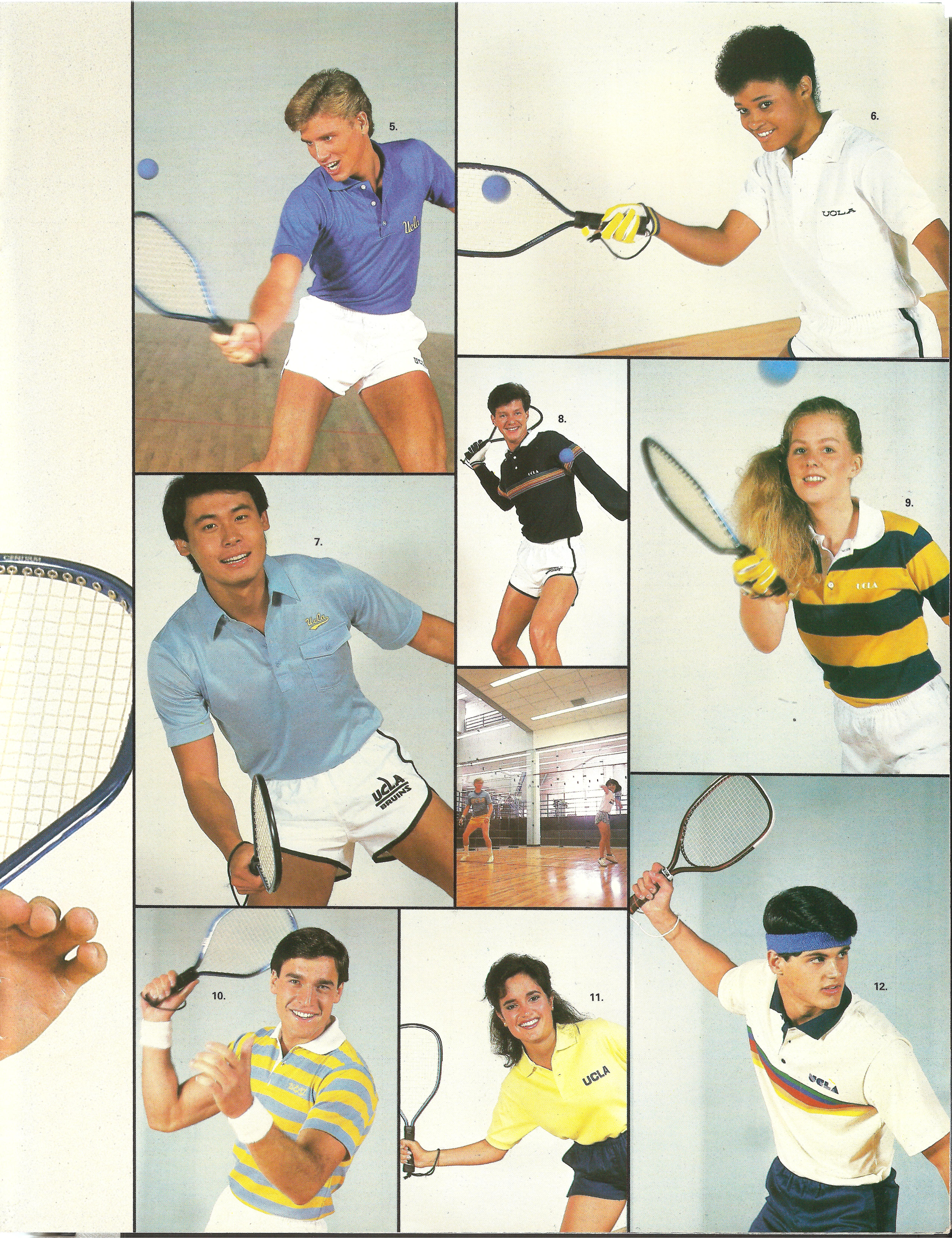
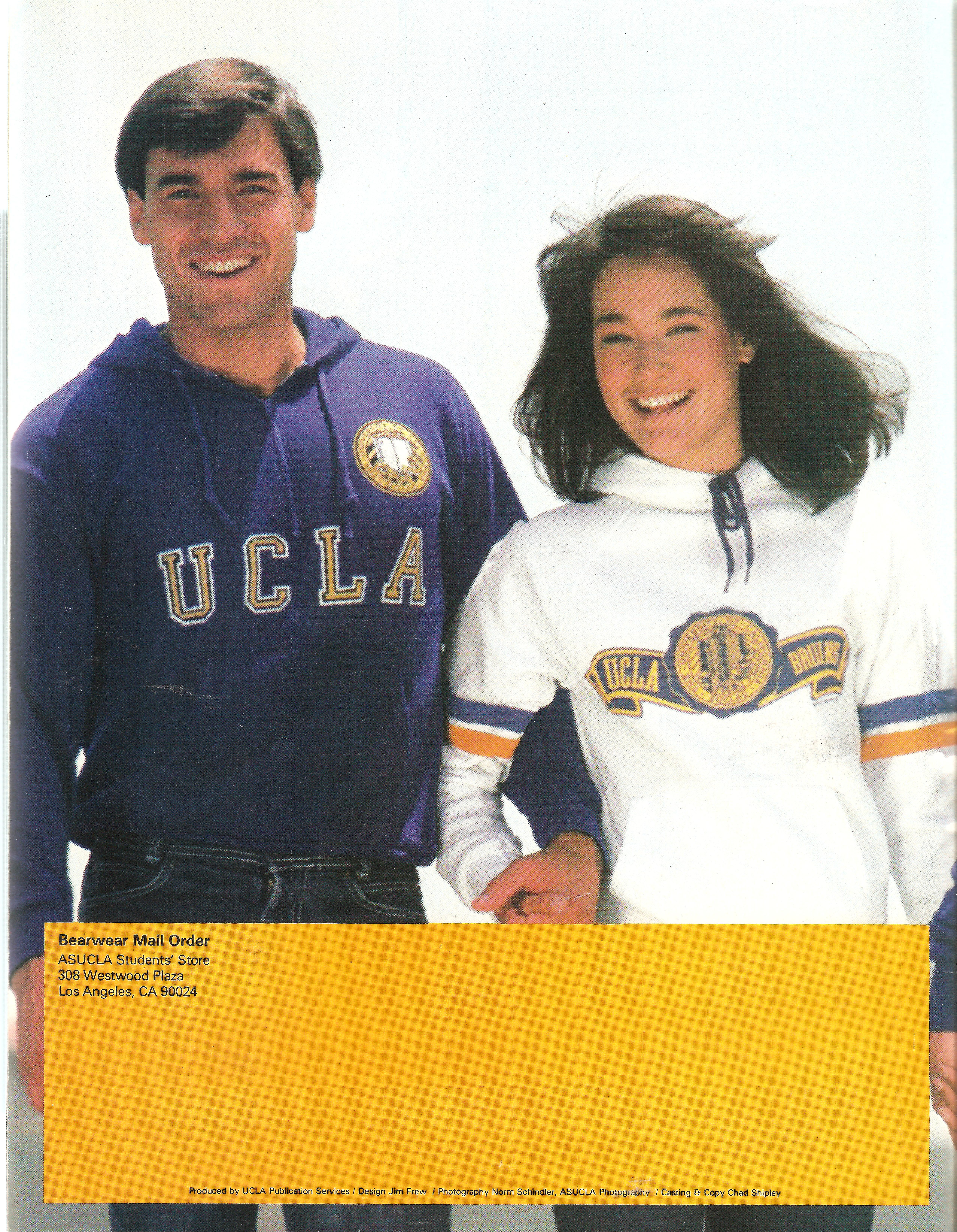
Slideshow of most of the 1984 catalog, above. They still publish a paper version of the catalog but nowadays you can buy Bearwear online here: https://www.uclastore.com/ (Once again, thanks to the birth of the Internet in 1983. Sorry, I do not believe they will honor the 1984 prices!)
 My Twitter feed lit up yesterday following a series of controversial and – it must be noted – unofficial tweets by Adam Orth, Microsoft Studios’s creative director. He was responding to negative comments on the rumored “always on” requirement for the next Xbox gaming console currently in development. “Always on” refers to a Digital Right Management (DRM) scheme designed to curb pirated games by checking their authenticity over an internet connection every time they are played.
Here’s the actual Twitter exchange:
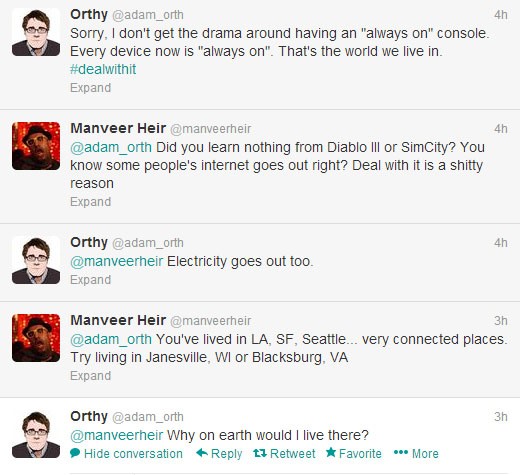
Adam Orth’s tweets.
From a public relations point of view this is bad for two reasons big reasons. First, companies don’t typically make public comments about unannounced products (even, or perhaps especially, if they are heavily anticipated). Here Orth is essentially confirming the existence of a controversial feature in an unannounced product. Secondly, he is doing it in an impudent and tone-deaf manner.
To make matters worse for Xbox’s PR team, Orth’s tweets and the subsequent Internet backlash were reported today by Forbes, The Huffington Post, CNET and many other news and gaming blogs. Part of what made the story so juicy was the easy availability of the Twitter graphic. It’s begs to be stuck in the middle of a post (like I just did).
The other thing that makes this story so irresistible is that it fits well into the narrative of Microsoft as an arrogant, uncaring behemoth. And I have to admit that it sounds remarkably like the type of comments I’d often hear internally at Microsoft meetings. It also sounds like Orth was just being flippant and jokey, not deliberately mean-spirited. I’ll bet he’s a nice guy. But it does confirm for me that Microsoft’s corporate culture remains far removed from the customer-centric view exhibited by the world’s most admired companies. I’m sure that any of Microsoft’s many official spokespeople would have handled this differently, but this snarky attitude would never have occurred in a company where each and every employee is focused on earning and keeping the customers’ trust. That’s the type of company I want to work for.
Postscript – This just in..
Thanks to the awesome power of social media, Microsoft Studio’s creative director is getting his 15 minutes of fame – but not in a good way. Less than 24 hours later Adam Orth’s comments have spawned several “Always On” internet memes and even a “Hitler hears about “always online” new Xbox” video.
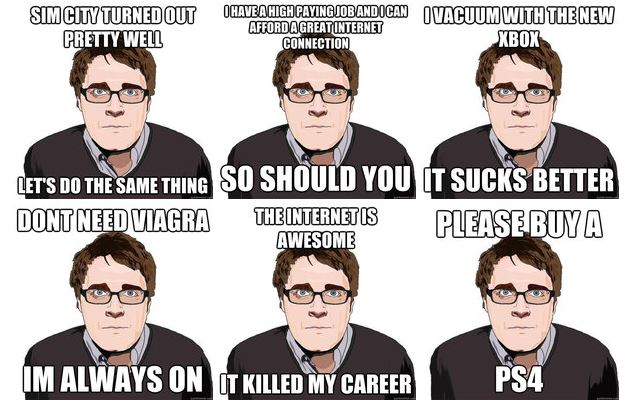
Some variations on the Adam Orth “Always On” internet meme. Source:_http://knowyourmeme.com/
This week I’m working with an early stage technology startup that’s anxious to issue its first press release. A good press release, also called a news release, demonstrates to an editor or reporter that a particular event, service or product is newsworthy. It is a time-honored mainstay of the public relations business. For many people a press release is PR. In fact, press releases are just a small part of what I do and in this brave new world of social media, they can be the wrong tool for disseminating some types of news. That said, going through the exercise of gathering the building blocks for a solid new release is never a waste of time. The process itself will help validate the newsworthiness of your announcement. And once validated, you can then decide which delivery medium best fits your message.
In my early days at Microsoft I worked on a project assisting third-party companies in drafting their press releases in support of a Windows product launch. In the space of a single week, I churned through over 100 releases. Many smaller companies needed a lot of hand holding – they weren’t sure where to start. Worse yet, others dove in confidently, but drafted press releases with so many holes that is was easier to start again from scratch. From that experience, I developed a questionnaire I still use today to help me formulate a solid news release. This list of questions is heavily influenced by my colleagues on various PR teams and the great outside agencies I’ve worked with along the way. It’s not rocket science. Journalism students will recognize them as digging for the “Five Ws” (who, what, where, when, why — and how). Here are the questions to ask before you start the actual writing:
Tom’s 10 Questions
1 – What is the one concept you want to convey in this press release?
2 – What is the role of this release in meeting larger PR goals?
3 – What are the key product/service features? How do they translate to benefits?
4 – What are the key messages for this release?
5 – Who is your target audience?
6 – What are your coverage expectations?
7 – What would your ideal article headline look like?
8 – What message do you want reflected in your company/customer quote(s)?
9 – What other company product/services will be impacted by this release?
10 – What is the call to action? What are the pricing and availability details?
The answers to these 10 questions provide the necessary building blocks for constructing a solid press release with realistic expectations of its impact. If you can’t answer them, or you don’t like the answers you’ve come up with, maybe you are not yet ready to make your news. But if you can, you have the raw materials to produce a number of other marketing communications collateral such as blog posts, advertorials, op-eds, etc. All you have to do now is follow the appropriate journalistic guidelines and formatting conventions. Oh, and be sure to add a healthy sprinkling of the magic dust that makes whatever you produce newsworthy and engaging.
Three Bonus Logistical Q’s (to get the job done!)
1 – Who is the press release owner/writer? (best not to split these)
2 – Who provides the approvals? (broken down by contribution, and overall)
3 – What’s the timeline? (create a work back schedule for every piece of the puzzle)
Follow the appropriate journalistic guidelines and formatting conventions when drafting your press release. AP Stylebook graphic – source: http://www.apstylebook.com/
I recently returned from a trip to Switzerland where I spent a week babysitting my six year old niece while her mother was away on business. Perusing an English bookstore, just off of the upscale Bahnhofstrasse, I spotted a paperback of Uncle Tom’s Cabin and decided it would be a good read for my flight back from Zurich to Seattle. Quite frankly, it was the right size, well over 400 pages but compact enough to be easily accessible from the outside pocket of my carryon. I was familiar with the book (or at least I thought I was) but had somehow never read it in high school or college. Moreover, the title, or more specifically the expression, “Uncle Tom” has a special meaning to me because my name is Thomas and as an uncle five times over I have often witnessed a knowing smile from friends and strangers after being called “Uncle Tom!” by a niece or nephew. This has even happened to me while in Switzerland where the erudite locals get some special satisfaction in poking fun at Americans.
So, I decided to pick up the novel in order to answer two questions – is it worth reading and just what, exactly, is an “Uncle Tom”?
Is it worth reading?
Uncle Tom’s Cabin (hereafter referred to as UTC) was the second best-selling book of the 19th century, after (you guessed it!) the Bible. Harriet Beecher Stowe wrote the novel to humanize the plight of the American slave system in a deliberate attempt to raise the profile of the abolitionist movement. Lincoln is reputed to have said upon meeting the author, “So this is the little lady who made this big war!” (That quote has been determined apocryphal by Lincoln scholars.) Given the novel’s historical importance I would say that it is indeed worth reading. It is also worth reading as a great work of progressive or reform literature – likely the most consequential reform movement in U.S. history (in those days the Republicans were the progressives!) A modern marketing communications professional might well ponder what today’s equivalent might be. Jason Russell’s KONY 2012 video campaign was a similar deliberate attempt at using modern popular media to fuel a movement. What would a contemporary Harriet Beecher Stowe do for the Gun Control efforts? If in the form of a novel, it would have to be as popular as Fifty Shades of Grey, while stirring readers to take action beyond simply downloading the next installment to their Kindles.

Harriet Beecher Stowe – Hulton Archive Getty Images
That said, UTC is not great literature. It is sentimental, preachy and often painfully long-winded. The novel seems disjointed at times, perhaps because it was originally a series published in an abolitionist newspaper. The stories don’t have a natural interplay and some of the resolutions seem forced. And because the author takes pains to address numerous variations on the theme (kind/evil masters, defiant/subservient slaves, prejudiced Northerners, neutral observers, bounty hunters, oblivious and arrogant southern belles, etc.) the reader can often hear the plot creaking as the author maneuvers it into place. The reader also gets a heavy dose of Bible quotes and references, from that other top-selling book from the 1800’s (and of all time, I believe, unless sales of Fifty Shades of Grey recently surpassed it).
What is an “Uncle Tom”?
In modern usage, an “Uncle Tom” is considered by most to be a derogatory epithet denoting a docile, submissive black man – a long suffering and dutiful servant who actually has sympathy for his suppressors. But here’s the amazing thing I learned from reading UTC from cover to cover– Uncle Tom is not an object of deprecation at all. In fact (spoiler alert!), Uncle Tom is the noblest of all characters found in the novel. He dies for (and as a result of) his sadistic slave owner’s sins. But he also dies for his fellow slaves as well as the kind-hearted slave owners and the Free State Northerners who mistakenly assume that they are innocent because they do not actively support the institution of slavery. In short, to a very devout Harriet Beecher Stowe (the daughter of a preacher, married to a preacher) Uncle Tom might be considered a kind of Jesus.
The connotation of the term “Uncle Tom” was turned around soon after the novel became popular because bolder voices in the abolitionist movement were calling for action. “Uncle Tom” became a convenient shorthand for a passive, submissive black man who would not join the movement for fear of upsetting the system (things could get worse!). And the novel itself gained a negative, racist reputation because of the stereotypes of black people that it helped popularize for the world: the heavyset, dark-skinned cook or “mammy”, the buffoonish Sambo, the pickaninny children of slaves, etc. The modern reader must acknowledge and condemn this, and get into a 1852 mindset in order to recognize this for the ambitious persuasive (i.e., political) writing this was at the time.
In Conclusion
If I haven’t convinced you to dedicate your next transatlantic flight to a 161-year-old bestseller, I can save you the time by summarizing the 400+ pages of the novel as follows:
- From a MarComm point-of-view, one lesson here is to choose the right medium. The novel was just coming into its own in the 1800’s and UTC found a ready audience on both sides of the Mason–Dixon line. A growing literate population found itself with long nights at home and 100 years to wait before they could turn on the TV. But more importantly, whichever medium you choose to create a groundswell for your progressive movement, be sure to connect with your audience on an emotion level. Feelings, not facts, motivate people to take action. UTC was written expressly to tug at the heartstrings of all sensible citizens.
- About three quarters through the novel a kindhearted master has an epiphany while reading the Bible to Uncle Tom. The passage is from Matthew 25, which I’ve provided below. From this reading the slave owner is shocked to realize that God also excludes those from heaven who do no good, not just those who refrain from doing evil. In other words he learns that, “All that is necessary for the triumph of evil is for good men do nothing.”* or less dramatically, “If you are not part of the solution, you are part of the problem.”** This for me was the primary lesson – or should I say reminder – from Uncle Tom’s Cabin.
* “All that is necessary for the triumph of evil is that good men do nothing.” has been widely attributed to Edmund Burke, but has not been found verbatim in any of his writings (see Citing Sources). Edmund Burke was an Irish political philosopher, a Whig politician and statesman who is often regarded as the father of modern conservatism. He lived and wrote about 100 years before the publication of UTC, from 1729 to 1797.
** “If you are not part of the solution, you are part of the problem.” has been attributed to Eldridge Cleaver from a 1968 speech. But Charles Rosner, a renowned advertiser and marketer (a MarComm Man!) wrote “If you’re not part of the solution, you’re part of the problem” for as a recruitment slogan for VISTA in 1967.
Matthew 25:31-46 – The Son of Man Will Judge the Nations (New King James)
“When the Son of Man comes in His glory, and all the holy angels with Him, then He will sit on the throne of His glory. All the nations will be gathered before Him, and He will separate them one from another, as a shepherd divides his sheep from the goats. And He will set the sheep on His right hand, but the goats on the left. Then the King will say to those on His right hand, ‘Come, you blessed of My Father, inherit the kingdom prepared for you from the foundation of the world: for I was hungry and you gave Me food; I was thirsty and you gave Me drink; I was a stranger and you took Me in; I was naked and you clothed Me; I was sick and you visited Me; I was in prison and you came to Me.’
“Then the righteous will answer Him, saying, ‘Lord, when did we see You hungry and feed You, or thirsty and give You drink? When did we see You a stranger and take You in, or naked and clothe You? Or when did we see You sick, or in prison, and come to You?’ And the King will answer and say to them, ‘Assuredly, I say to you, inasmuch as you did it to one of the least of these My brethren, you did it to Me.’
“Then He will also say to those on the left hand, ‘Depart from Me, you cursed, into the everlasting fire prepared for the devil and his angels: for I was hungry and you gave Me no food; I was thirsty and you gave Me no drink; I was a stranger and you did not take Me in, naked and you did not clothe Me, sick and in prison and you did not visit Me.’
“Then they also will answer Him, saying, ‘Lord, when did we see You hungry or thirsty or a stranger or naked or sick or in prison, and did not minister to You?’ Then He will answer them, saying, ‘Assuredly, I say to you, inasmuch as you did not do it to one of the least of these, you did not do it to Me.’ And these will go away into everlasting punishment, but the righteous into eternal life.”
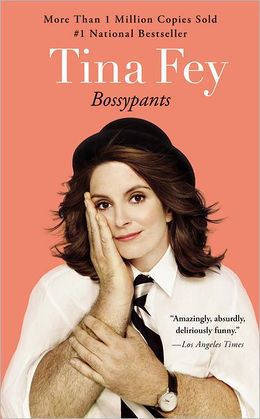 I downloaded the audio version of Tina Fey’s Bossypants. I figured I was going to hear her voice in my head while reading it anyway, why not actually hear her voice? It’s a breezy and entertaining autobiography. If you enjoy the TV show 30 Rock (which aired its last episode today) you’ll enjoy this book.
My happiest discovery in this book was the rules for doing Improv as a model for leading your life. I’ve heard this idea before, and the best MarComm folks I know do these things instinctively. It doesn’t hurt to have a handy reminder. You can find all sorts “Improv” rules on the web, but Ms. Fey does a great job of boiling them down to just the following four which even you/I can remember:
- Rule #1 – Always agree and say yes. When you’re improvising, this means you agree with whatever your partner has created. When I am in a meeting, my initial reaction to new ideas is to try and make them work. This leads nicely to rule #2…
- Rule #2 – Don’t only to say yes, say yes, and. Agree silently if screaming “Yes!” isn’t appropriate at the moment. And then add something of your own: “Yes, we can do the product launch in New York – I think there’s a major tie-in with Fashion Week.”
- Rule #3 – Make statements. In other words, be positive; don’t try to shoot down the idea. I’ve been in many meetings where folks seem to enjoy pointing out all the obstacles. As a colleague used to say, “Any jackass can kick down a barn.” But an Improviser looks for solutions: “A New York launch can be expensive – let’s look for some unconventional venues so we can make this work!”
- Rule #4 – There are no mistakes, only opportunities. Often the funniest things happen in Improv due to misunderstanding and “happy accidents”. If – even after following rules #1-3 – your best laid plans go awry, deal with what you have. It’s not a mistake if you can create an opportunity. “After all that planning, the New York launch must be cancelled because of snow”… quick improvise!!!
For a much funnier version of these rules get yourself a copy of Bossypants and look for the chapter entitled “Tina Fey’s Rules of Improvisation That Will Change Your Life and Reduce Belly Fat* (*Improv will not reduce belly fat). Bossypants is an autobiographical comedy book written by Tina Fey, originally published April 5, 2011. The paperback edition was release earlier this month. The audio book is available on Audible.com.
For MarComm folks the term “swag” means “promotional items,” especially those given away for free at tradeshows and product launches. I’ve been thinking about the word lately because it’s coming time for me to retire my favorite swag of all time. When I mentioned this sad news with my teenage daughter she looked at me incredulously. It turns out the term “swag” means something totally different to her.
In fact, the term “swag” has several meanings, including: illegally obtained goods (think pirates’ booty), a decorative garland, a valance or drapery, or a decoration made up of flowers or fruit. The current Urban Dictionary definition for swag begins, “The most used word in the whole #@!% universe…” I’m pretty sure that’s not true (on earth and in English it’s the word, “the”). The Urban Dictionary entry is referring to the proliferation of the term swag on the internet and in popular culture to describe a person’s style, attitude, or appearance, as in “Justin Bieber’s got killa swag.” It is similar to the term “swagger,” a panache or presence that exudes confidence. Last year NPR’s “All Things Considered” declared swag “hip-hop’s word of the year” Now you can understand my daughter’s confusion because in her eyes I have no swag and if I did, swag is something you can’t give away, either you’ve got it or you don’t.
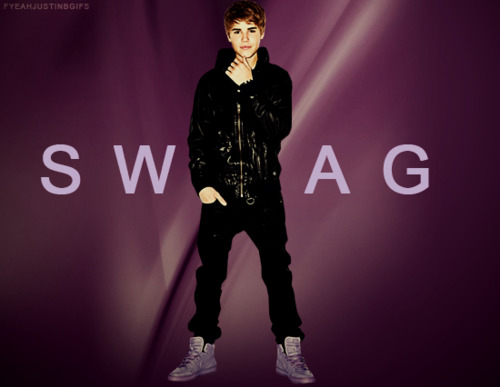
People tell me that Justin Bieber has swag.
But I digress, in my world swag means tchotchkes, that “Stuff We All Get” at tradeshows and events. From a marketer’s point-of-view the best type of swag is easy to reproduce in quantity (i.e., cheap) but appreciated and used often by your target customer. Bonus points if it is highly visible and usable within a context that would lead to a sale or call to action. One piece of swag I recently admired was a rubber grip for opening jars with the contact info for an arthritis clinic. Pens with a company name and logo are always a safe bet. A few years ago pens were mostly supplanted in the hi-tech world by logoed USB flash drives. I once ordered several thousand Windows logoed pens that contained a hidden USB flash drive on the top half, the best of both worlds! In a previous post I’ve mentioned inexpensive swag such as refrigerator magnets (now out of fashion) and shoelaces (a surprising hit), but not all swag is cheap. In the past I’ve handed out LCD photo frames and pricey neoprene jackets to “key influencers” at more exclusive events. And the value of the Academy Awards Oscar swag bags easily reaches into the tens of thousands of dollars each year.

My favorite piece of swag – circa 2008.
The best piece of swag I ever personally received was a Windows 95 gym bag given to employees at the launch party. It wasn’t necessarily a great piece of promotion as the logo blended into the fabric. But because the logo was so subtle and the duffle was such a perfect size I used it for many years as my primary workout bag. In other words, it was great for me, but didn’t do much to spread Windows goodwill. But alas, after all those years a couple of the zippers went off track and it’s getting awkward to use, so now it’s time for me to retire the duffle bag from daily use.

Will Ferrell has (ironic) swag!
 An old friend and colleague recently forwarded a tribute to Windows NetMeeting written by a Melbourne-based blogger (I’m Tipping My Hat To You, by Tim Bookes). It warmed my heart on this cold November morning to see that something I worked on long ago left such a lasting impression on the author and many others. For those unfamiliar, NetMeeting was an audio/video and conferencing application included in many versions of Internet Explorer and Windows 95 (OSR2) through Windows XP. Development and marketing for NetMeeting stopped soon thereafter. With the announced end-of-support date for Windows XP, (April 2014) this technology will finally be laid to rest. Check out Tim Bookes’ well written eulogy for more background.
Early in my Microsoft career I was a technical evangelist together with the old friend that brought Bookes’ article to my attention. Our job was to help get users and developers excited about this new technology during the beta (pre-release) and first full release. The beta version was codenamed “Oprah” because it was audio-only and was destined for big things (at the time Oprah Winfrey had the biggest talk show on the planet.) My office was in the same hallway as much of the development team and the distinctive “handshake tone” as the NetMeeting app sought and established connections between users, could be heard ringing up and down the hallway day and night.
In those days (late-90’s) I felt as though I was involved in every step of the process from the initial NetMeeting feature outlines, to bringing the product to market. Later, as the Product Manager, I went on to develop the marketing, branding and launch plans for versions 2 and 3. NetMeeting was included in every shipping version of Windows, Internet Explorer and all of the major PC cameras available on the market, and quickly rose to become the most widely used VOIP (voice over IP) and video-conferencing application in the world. As the NetMeeting PM I established the target market, created tables of features and benefits, wrote data sheets, demo scripts and user guides. I also owned the content on our fledgling website. I ordered “Have You Net Met Yet?” NetMeeting logo swag like refrigerator magnets (great for erasing 3.5” diskettes when used as cozies) and bright yellow NetMeeting shoelaces (surprisingly, a big hit amongst employees and external enthusiasts). For one particular Las Vegas tradeshow I purchased a 15 by 32 foot vinyl banner. It spent years afterwards rolled up in my garage waiting for the day my roof might leak.
I also wrote up the user case studies and created the screen shots we provided to press. Here’s one example:
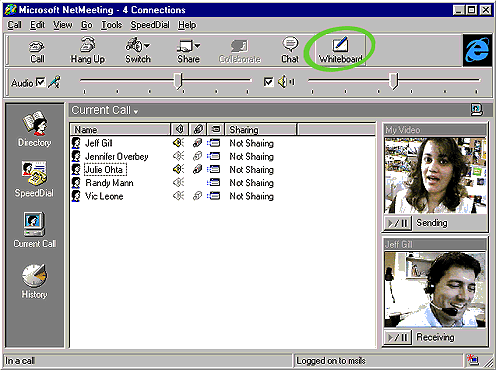
The main NetMeeting screen for a multi-point conference. That’s me in the bottom photo, with a colleague above (I want to say, Sandra?). The names of the conference participants were mostly amalgams created by mixing up the names of coworkers.
Today Skype is the number one video-conferencing application and NetMeeting has been mostly forgotten. This is because Microsoft made the strategic decision to halt its development and, as Tim Bookes notes, because it was a product before its time. In the days of dial-up connections, Internet speeds were not fast enough for most users. The newly introduced USB 1.0 cameras were themselves too slow and the technology used for video conferencing and application sharing was too complex (and too inflexible) for many third party developers. When the marketing and development for NetMeeting ended with the release of Windows XP the door was opened for Skype and other products to fill the space. In 2011 Microsoft purchased Skype for $8.5 billion – i.e., the cost of abandoning the market ten years earlier. But the experience I gained working on all aspects of NetMeeting marketing and communications in those early years was invaluable. As I moved on in Microsoft, teams grew in size and complexity and I began delegating many of these roles. Windows Media Center was another opportunity for me to live through a product’s lifecycle from beta through three vital and exciting releases, as well as its abandonment and neglect as strategies changed. Along the way I worked on more than a dozen other product launches, including several for Internet Explorer and Windows Live. But NetMeeting was special – and you always remember your first.
Here’s a 4 minute clip of a June 1999 demonstration of NetMeeting video conference. The connection was a bit shaky and moments before air I realized that the headset wouldn’t reach my head. But it’s worth watching for the last 30 seconds….
 Times Square lights up in Windows 8 colors at midnight, last night.
New York, New York – Windows 8 Launch. I’ve written about Windows 8 in the past, on the occasion of the first consumer preview, the announcement about Microsoft going into the hardware business with Surface, and of the rolling thunder public relations campaign which reaches its crescendo today. And I’ll surely be writing about Windows again as the marketing communication challenges facing Microsoft with this release have just begun. But today – launch day for Windows 8 and Windows RT tablets – I simply want to address the question I’ve been getting from friends and family, should I buy it? My answer is simple: yes, no, and maybe.
Windows 8 represents the most significant change in the ubiquitous PC operating system since the introduction of the Start button with Windows 95. Some would argue that it’s the biggest transformation in the user interface (the way you interact with your screen) since Microsoft made the shift to a graphical user interface (GUI) more than 25 years ago. But beyond that Microsoft is betting the bank that they can kick start (“reimagine” is the term they like to use) their desktop, tablet, and mobile phone efforts all at once. It’s this strategy that drives the significant changes you will see in Windows.
If you are in the market for a new Windows laptop or desktop PC, you should buy a touch enabled (note emphasis) device with Windows 8 installed. The Microsoft version of this is called Surface Pro. Even Mac aficionados ought to pause to consider some of the versatile options coming onto the market from all the major manufacturers, though I don’t predict many will be swayed. Yes, Windows 8 looks different and there will be a learning curve, but there is no reason to “downgrade” a new PC to Windows 7 as some people downgraded to Windows XP during the dark days of Windows Vista (granted, I also thought that was a wild overreaction). You’ll figure Windows 8 out and (eventually) you’ll be happy you did. If you can, wait for the “dot update” (meaning version 8.1, or whatever they call it) to smooth out some of the rough edges.
On the other hand, for most people there is little reason to upgrade their current laptop or home PC to Windows 8. This is because Windows 8’s primary advancement is the new user interface designed to work well with touch screens (using your finger as an alternative to the mouse) and very few people have touch sensitive screens on their existing PCs. I have little doubt that this will change over time. Today’s standard PC displays will eventually be replaced by the touch sensitive variety in the same way that the CRT (tube-based) displays were displaced by flat panels. In the future, it will be as peculiar to use a PC without a touchscreen as it is to use one without a mouse today (possible, but peculiar). But this switch will happen over time as older computers are replaced, many with laptops and all-in-one designs. Only true geeks will be adding a touch sensitive screen to an existing computer setup – and those folks aren’t asking for my advice.
In summary: yes, get Windows 8 on your new touch enabled PC or laptop if it’s time for a new PC anyway. Don’t get if you are against change, hate the whole notion of a touchscreen, or you are perfectly happy with your current setup. Here’s the maybe: If you are in the market for what I would call a “productivity tablet” (think iPad with a keyboard and Microsoft Office) you might want to consider a Windows RT machine. This is Microsoft’s attempt to create a Windows version of the locked-down iOS Apple uses on their iPads, iPods and iPhones. You can only get Windows RT on new devices from a handful of manufacturers and you can only use applications designed specifically for RT (legacy Windows applications won’t work). The majority of hardware (USB mice, keyboards, printers, etc.) should work just fine. Steven Sinofsky, President of the Windows Division, called Windows RT “An amazing expression of Windows.” I call it “Windows-Lite” or “Windows 8 for tablets only.” A brave attempt to launch a new platform, but for now my money is on the full featured Windows.
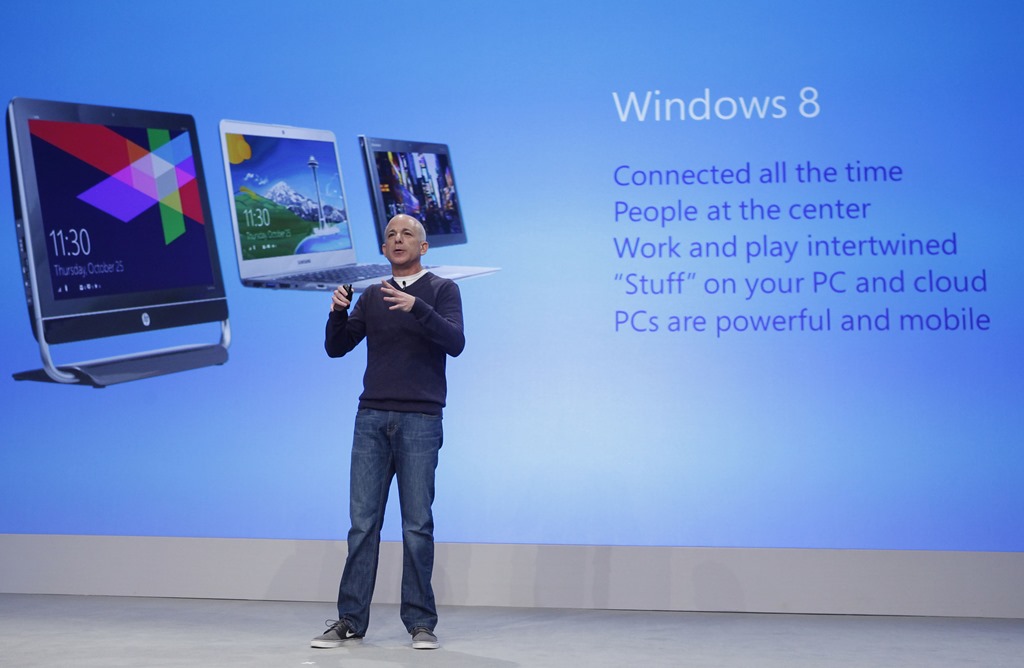
Steven Sinofsky, President of the Windows Division, at the Windows 8 launch. The image behind him shows the three primary PC form factors: All-In-One, Laptop and Tablet.
 marcommman